Pencil Drawing for the Armed Forces of Ukraine: Ideas, Symbols and Simple Steps
A pencil drawing for the Armed Forces of Ukraine is a picture drawn by hand — most often by a child, a student or an amateur artist — to thank the soldiers of Ukraine (ЗСУ, ZSU: Збройні Сили України, the Armed Forces of Ukraine) and to lift their spirits. It asks for nothing but paper and a pencil, and the Ukrainian guide this article follows sets out why such a drawing matters, what to put in it and how it reaches the people it is drawn for.
The practice behind the guide is real and documented. Ukrainian universities and schools run collections of drawings and letters for the military, volunteers carry them to the front, and exhibitions of children’s drawings have been held in Kyiv and abroad. The University of Notre Dame’s Nanovic Institute, writing about the children’s art collected since 2022, records that soldiers on the front line who receive the drawings are heartened by them.
Below you will find the symbols these drawings use and what is actually documented about them, the simple kit and pencil grades that suit the work, the guide’s step-by-step plan and its ideas for subjects, why children’s drawings carry the weight they do, how drawings are passed on through schools and volunteers, and short answers to the questions people ask most.
Why It Matters to Draw a Pencil Drawing for the Armed Forces of Ukraine
The guide gives three reasons, and they are simple ones. First, things made by hand carry sincere emotion in a way a bought card does not: the uneven lines are the proof that a real person sat down and thought about the soldier who will hold the page. Second, even the smallest drawing can become a source of strength for a defender far from home — a reminder of exactly who is waiting and hoping. Third, the pencil is the most accessible tool there is: no paints, no printer, no cost. Anyone who can write can draw one.
What Elements to Add to a Pencil Drawing for the Armed Forces of Ukraine
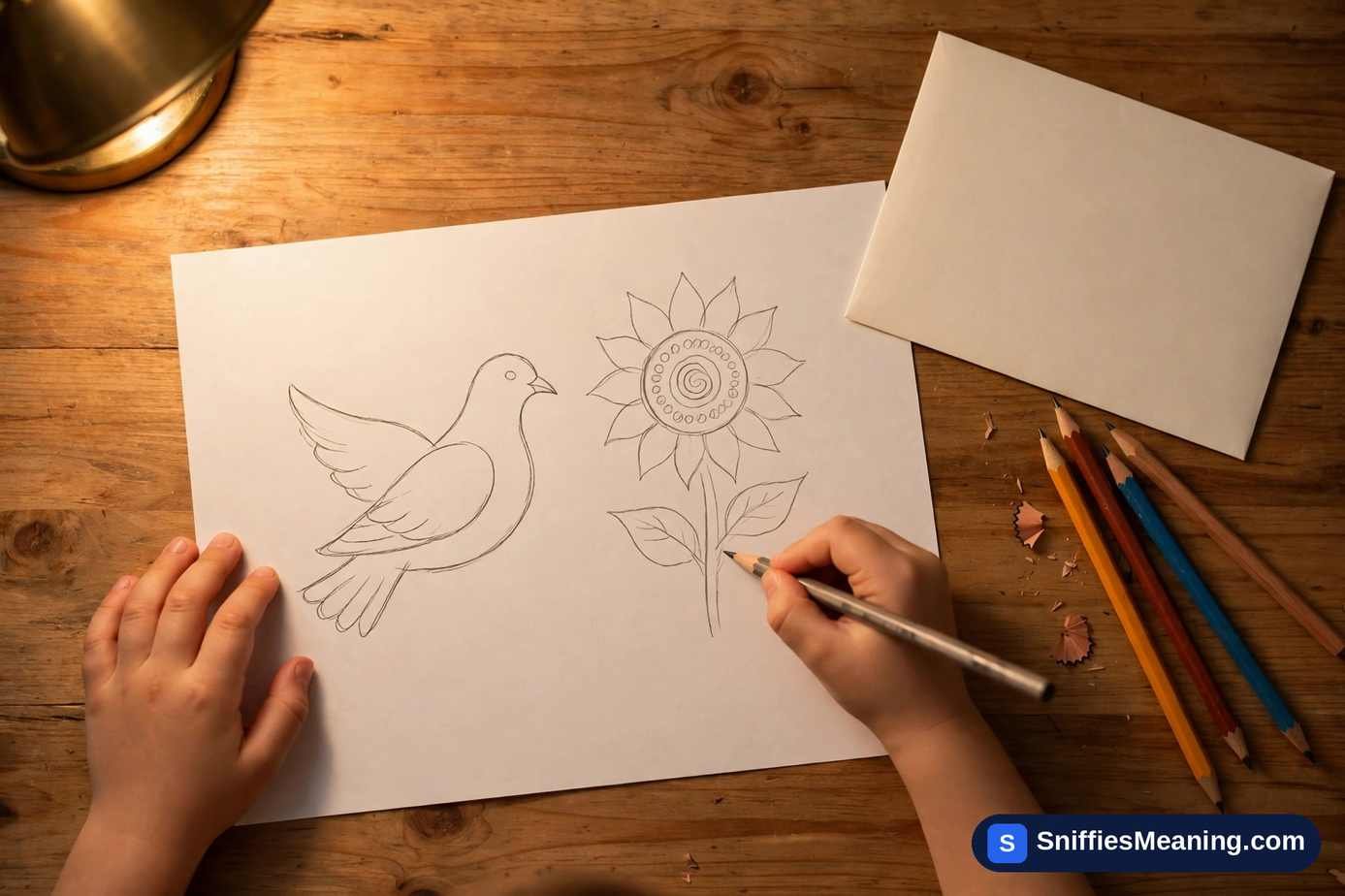
The guide’s advice is to think about the symbolism before the first line. Its core elements are the Ukrainian flag, the coat of arms and the sunflower — the flower it calls a symbol of unbreakability — and around them, a few sincere written words, such as «Дякую!» (“Thank you!”) or «Повертайтеся живими!» (“Come back alive!”). A heart, a dove or a patch of peaceful sky fills the rest of the sheet.
The written words are not decoration; for many soldiers they are the part that is read twice. Choosing them well is a small craft of its own — this site’s guide to words of thanks to soldiers covers what to write when the message matters as much as the picture.
The Symbols Behind the Drawing: Flag, Tryzub and Sunflower
Each of the guide’s three symbols has a documented record behind it, and the record is worth the two minutes it takes to read — a drawing means more when its maker knows what the signs actually are.
The flag is the easiest element to draw and the hardest to get wrong: two equal horizontal bands, blue above yellow, in a plain rectangle. The blue-and-yellow flag was officially restored as Ukraine’s state flag on 28 January 1992. The reading most often given for the colours is blue sky over golden wheat fields; Ukrainian law fixes the colours themselves, and the sky-and-fields reading is the popular one, printed here at that strength.
The coat of arms is the tryzub — a gold trident on a blue shield — adopted as Ukraine’s small state coat of arms on 19 February 1992. The sign is far older than the modern state: it was stamped on the gold and silver coins of Prince Volodymyr the Great (980–1015), more than a thousand years ago. What the sign originally meant is honestly not settled — historians have proposed several readings and none is certain — so this article prints none of them as fact. For the drawing, what matters is its shape: three prongs rising from one base, drawable in a dozen lines.
The sunflower (соняшник, soniashnyk) is Ukraine’s national flower, grown in the region since the mid-18th century, first for its seeds and oil. It has long stood for peace — in June 1996, ministers from the United States, Russia and Ukraine planted sunflowers at the Pervomaysk missile base to mark Ukraine’s nuclear disarmament — and since 2022 it has become a worldwide symbol of resistance, unity and hope. The guide’s word “unbreakability” is its own gloss on that same record.
How to Prepare to Create a Pencil Drawing for the Armed Forces of Ukraine
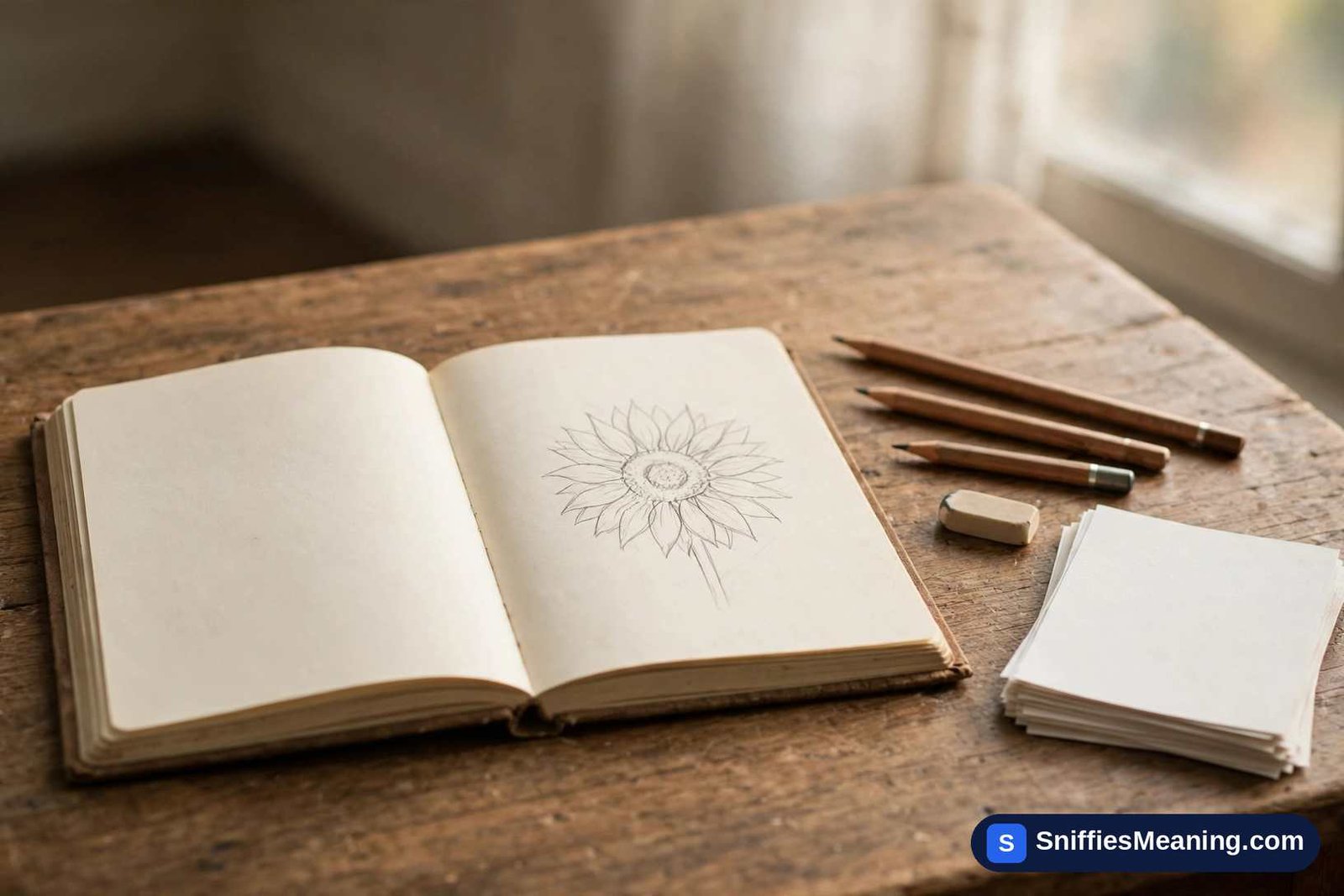
The guide’s preparation is short: a clean sheet of paper, a good pencil, and a decision about which feeling the drawing should carry. That last point is its real instruction. A drawing for a defender is not an exercise in neatness — it should be sincere before it is beautiful — so choose the subject and the words first, and let the lines follow. A sheet kept flat and clean, and a few minutes of quiet to think, are the whole of the preparation.
Pencil Grades, Paper and Erasers: The Simple Kit
One practical addition the guide does not make: pencils are not all the same, and the letters stamped on them are a real, manufacturer-documented system. A pencil’s core is graphite mixed with clay. More clay makes a harder core that leaves a lighter, sharper line — the H grades. More graphite makes a softer core that leaves a darker, broader line — the B grades. HB, the ordinary school and office pencil, sits in the middle. Faber-Castell, the world’s largest pencil maker, sells its Castell 9000 drawing range in grades from 8B to 6H and recommends the soft 3B to 8B grades for artistic shading.
For one of these drawings, the working kit is therefore small: an HB for the outlines, a 2B or 4B for shading the flag’s upper band, the sunflower’s centre and any shadows, an ordinary eraser for corrections, and smooth white paper — a plain A4 sheet is what most school drawings use. Nothing here needs to be bought specially; the set most homes already own covers it.
Step by Step: How to Create a Pencil Drawing for the Armed Forces of Ukraine
The guide’s plan has four steps, and they work for an adult’s careful drawing and a child’s first one alike:
- Draw the outlines of the Ukrainian flag. A rectangle, split across the middle into two equal bands. Light lines first; the shading that separates the bands comes later.
- Add the figure of a defender. Keep the figure simple — a standing figure built from basic shapes, the way the guide’s own young readers draw one. A clear silhouette reads better than attempted detail.
- Decorate the composition with symbolic elements — sunflowers at the flag’s foot, or doves of peace in the sky above it.
- Write a few warm words on the sheet. A short line of thanks or a wish for a safe return, in your best handwriting, in the space the composition leaves.
Such simple steps, the guide notes, help even children create a sincere drawing.
Ideas for Inspiration: What to Draw for the Armed Forces of Ukraine in Pencil
When the blank page resists, the guide offers four proven subjects. The Ukrainian coat of arms, drawn large and central. A guard standing beside the flag. A family waiting for a defender’s return — a house, a window, the people at it. And the lightest option: the whole scene drawn in a comic or cartoon style, because a drawing that raises a smile has done its work too.
Why Children Should Draw a Pencil Drawing for the Armed Forces of Ukraine
Children’s drawings have a power no printed card matches, and the guide is plain about why: when a soldier receives a drawing made by a child, he feels real care and hope — the drawing says that the youngest people in the country he defends are thinking of him. The documented record agrees at full strength. UA Kids Today, the online collection of Ukrainian children’s art founded by Kyiv parents Artem and Anastasia Bykovets and described by the University of Notre Dame’s Nanovic Institute, gathers drawings children have made since 2022; the institute records that front-line soldiers receiving such drawings are revitalised by the hope and determination in them. The guide’s conclusion follows: encourage children to draw these drawings, and to draw them often.
How to Send a Pencil Drawing for the Armed Forces of Ukraine to the Front
Making the drawing is only the first step; the guide names the three routes by which drawings travel: through volunteer organisations, by post, and through school campaigns. The documented examples follow exactly those routes. The West Ukrainian National University in Ternopil announced a drive collecting drawings and letters for the Ukrainian military — the children of its staff were invited to take part — with the collected drawings handed to volunteers and sent to the front. Schools run the same pattern at their own scale: a class draws, a teacher gathers, and the bundle leaves with a volunteer or by post to where it is waited for.
A Pencil Drawing for the Armed Forces of Ukraine: Emotions That Change the World
The guide asks the reader to remember what the sheet of paper actually is: more than a picture — a message of hope, support and gratitude. Sometimes a simple drawing can give strength and inspiration to a person whose days are spent far from everyone the drawing shows. That, and not artistic quality, is the measure of whether it worked.
Tips for Creating a Better Pencil Drawing for the Armed Forces of Ukraine
The guide’s five tips, kept in its order:
- Use clear outlines — a drawing that reads at a glance travels best.
- Avoid gloomy dark tones — the message is hope; keep the shading light.
- Add positive symbols — the sun, flowers, hearts.
- Write sincere words of gratitude — a few, honestly meant.
- Draw from the heart, even if the drawing comes out imperfect — sincerity is the whole point of the exercise.
What Not to Draw: Keeping the Drawing Kind
One distinction is worth making plainly, because the record contains two different kinds of children’s drawing. Children living through the war also draw what they themselves have seen and felt — the travelling exhibition Children Draw War, Not Flowers, built from more than 450 drawings by children aged 6 to 18 from the Cherkasy region, shows soldiers, angels guarding them, sunflowers and storks alongside the harder scenes of their own experience. That is children’s own testimony, and it belongs to them.
A drawing made as a gift of support has a different job. Its reader is a tired person far from home, and the guide’s own tips set its register: clear, bright and hopeful — the flag, the sunflower, the family at the window, the words of thanks. Nothing in this article asks a child to hide what they feel; it simply keeps the gift drawings, which are this page’s subject, aimed at the comfort they are meant to carry.
How a Pencil Drawing for the Armed Forces of Ukraine Affects the Defenders
The guide reports that, by the feedback of many soldiers, drawings support their morale: the drawings remind them that their efforts are not in vain, and through them the defenders feel an invisible but strong connection with the people they protect. That is the page’s claim, and it is printed here as one — but it is a claim the documented record supports. The Nanovic Institute’s account of children’s drawings reaching the front line describes the same effect from the receiving side, and the War Museum in Kyiv, after exhibiting children’s drawings in 2022, arranged for part of the works to be sent on to the defenders at the front — museums do not forward paper that nobody wants.
A Pencil Drawing for the Armed Forces of Ukraine in School Projects
Many schools organise special events at which children draw pictures for the military, the guide says — and the record shows them doing it at scale. The Cherkasy collection behind the Children Draw War, Not Flowers exhibition began as a drawing competition run across 40 public regional libraries in the autumn of 2022, which produced more than 450 artworks by children aged 6 to 18. The guide’s second point is the teachers’ one: such projects do not only support the Armed Forces — they teach children gratitude and kindness, and they give a class its gentlest way to talk about the value of peace.
Exhibitions of Pencil Drawings for the Armed Forces of Ukraine
Exhibitions of these drawings are a documented part of the story, not a hope. The National Museum of the History of Ukraine in the Second World War — the War Museum in Kyiv — exhibited about 150 drawings by Ukrainian and Polish children, works created in May 2022 through a Polish foundation’s campaign of drawings and postcards addressed to Ukraine’s defenders; after the exhibition, part of the works were to be sent to the defenders on the front line. The Cherkasy children’s collection travelled the other way: 60 of its drawings were selected for a travelling exhibition shown at universities in the United States. The guide says such exhibitions shape public awareness — they show how much it matters to remember the people who risk their lives daily — and on the documented record, that is a fair description.
A Pencil Drawing for the Armed Forces of Ukraine as Part of National Culture
Drawings for the Armed Forces are becoming part of Ukraine’s contemporary culture, the guide says: through them the country keeps its memory, its emotions and its pride, and the pencil drawing becomes a small symbol of the unbroken Ukrainian spirit. Printed as the guide’s reading, it is also the conclusion the exhibitions point to — objects collected by universities, archived by institutes and exhibited by the national war museum are, by any ordinary measure, already cultural record.
A Pencil Drawing for the Armed Forces of Ukraine: What Else Can You Add
Beyond the traditional symbols, the guide suggests landscapes: a field, a river, a flowering garden — pictures that remind a defender of what he is defending. Smiling people, happy children and a peaceful sky belong to the same register. In pencil, all of these are within a beginner’s reach: a horizon line, a band of flowers, a sun with a face if the artist is young enough to insist on one.
How to Teach a Child to Draw a Pencil Drawing for the Armed Forces of Ukraine
The guide’s method is the right order of operations: begin with simple forms — draw the flag, or a heart — then invent the scene together, and while drawing, tell the child why they are doing it. That conversation is what turns the drawing from a craft exercise into what the guide calls it: a sincere act of care. A child who knows whose hands the page is travelling to draws a different page.
Supporting the Armed Forces of Ukraine Through Creativity: A Pencil Drawing
Creativity has always been a source of strength, and the guide closes on its widest claim: through drawings, the Armed Forces can be supported without great effort, and everyone who has ever drawn one becomes part of a large community of grateful Ukrainians. The claim needs no embroidery. A drawing is one member of a wide family of homemade thanks — this site’s collection of thank you pictures for the Armed Forces of Ukraine gathers the same gratitude in finished form — and the pencil version is simply the one anyone can make tonight, at a kitchen table, with what is already in the drawer.
Frequently Asked Questions About a Pencil Drawing for the Armed Forces of Ukraine
What is a pencil drawing for the Armed Forces of Ukraine?
A picture drawn by hand in pencil — usually by a child or student — to thank and encourage Ukrainian soldiers.
It is a message of support first and a picture second.
What symbols are used in a pencil drawing for the Armed Forces of Ukraine?
Most often the Ukrainian flag, the tryzub coat of arms, sunflowers, hearts and doves of peace.
Each is simple to draw and understood at a glance.
Do you need to write words on a pencil drawing for the Armed Forces of Ukraine?
Yes — warm words are the drawing’s most personal part, and the guide treats them as essential.
A short “thank you” or a wish for a safe return is enough; sincerity counts, not length.
Where can you send a pencil drawing for the Armed Forces of Ukraine?
Through a school collection, a volunteer organisation, or the drawing-and-letter drives schools and universities run.
The documented drives hand the collected drawings to volunteers, who carry them to the front.
Why is it important to draw a pencil drawing for the Armed Forces of Ukraine?
Because it carries warmth, gratitude and support across any distance, at no cost but time and care.
The documented record shows the drawings are received exactly that way.
Conclusion
A pencil drawing for the Armed Forces of Ukraine is the smallest complete act of support this run of articles has covered: one sheet of paper, one ordinary pencil, a flag, a sunflower and a few honest words. The Ukrainian guide that set the pattern gets the essentials right — think about the symbols, keep the lines clear and the tones hopeful, write the words sincerely, and send the drawing on through a school or a volunteer. The documented record adds only this: the drawings really are collected, exhibited and carried to the front, and they really are received as the messages they are.
If you draw one, draw it the way the children in the exhibitions drew theirs — from the heart, without worrying whether it is good. A pencil drawing has never needed to be a masterpiece to do its work; it needs only to be meant.