Thank-You Pictures for the Armed Forces of Ukraine: Kinds, Ideas and How to Share Them
The most valued thank you pictures for the armed forces of ukraine are rarely bought or downloaded — they are drawn, printed and posted by ordinary people who want Ukraine’s defenders to know their service is seen. A picture travels where a long letter cannot: onto a phone screen, a classroom wall, a parcel, a noticeboard.
A picture also asks nothing of the person who receives it. It needs no translation, no reply and no occasion — a child can make one, a class can make fifty, and a single bright image can sit in a soldier’s pocket or phone long after the day it arrived.
Below you will find the main kinds of these pictures, a step-by-step way to create your own, simple designs anyone can draw, honest guidance on finding ready-made ones, and the kind ways to share them so they actually reach the people they are for.

What Kinds of Thank-You Pictures for the Armed Forces of Ukraine Are There?
Pictures of thanks differ in style, format and content, and the competitor page groups the most popular into four kinds — patriotic designs, children’s drawings, artistic illustrations, and quotes over images. Each kind is covered below.
Patriotic Pictures with Ukrainian Symbols
The most recognisable kind is built from the country’s own symbols. The blue-and-yellow colour pairing carries most designs — sometimes as a simple two-band background, sometimes as a heart, a ribbon or a field of wheat under a blue sky. The tryzub, the gold trident that forms Ukraine’s coat of arms, is often paired with a short line of support, and sunflowers appear everywhere: the sunflower is Ukraine’s national flower, and it has become a worldwide emblem of hope and resilience, which is exactly the message these pictures send.
Keep this kind simple. One symbol, drawn large, with a few words beneath it reads clearly at any size — on a phone screen, a printed card or a poster in a window.
Drawings Made by Children
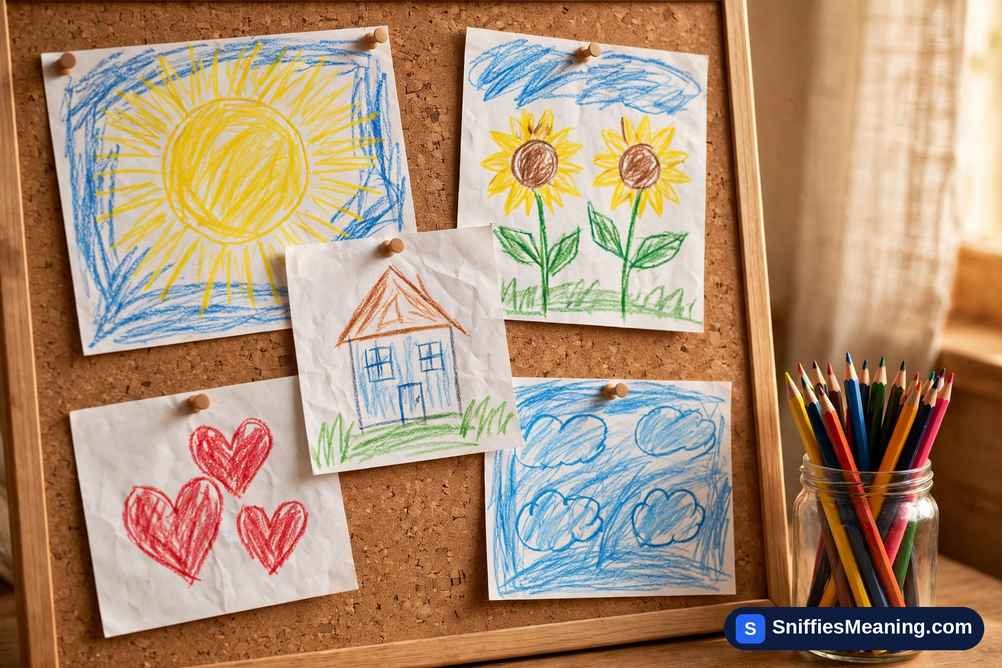
Children’s drawings are, by every account from the people who receive them, among the most treasured pictures of all. Their subjects are the ones children actually think about: a big sun, a house, a family, flowers, hearts, a soldier drawn as a tall hero, a defender being handed a bunch of flowers. The drawing skill does not matter — a crooked sun in crayon says “we are thinking of you” as clearly as any polished design.
One short line underneath is enough: a thank-you, a name, an age, a town. Keep drawings bright and hopeful — home, peace, sunshine — and let the child choose the subject; the honesty of the choice is the gift.
Artistic Illustrations on a Military Theme
Illustrators and artists produce the third kind: composed artworks on a military theme. These include symbolic figures — a defender standing against a sunrise, a falcon in flight, a Cossack from the country’s older stories — as well as quieter scenes of home, fields and flags. They are the kind most often shared online, because a strong composition travels well from screen to screen.
One honest caution belongs with this kind: an illustration has an artist. If you reuse one, keep the artist’s name or signature on it where it appears, and check whether the artist has offered the work for public sharing before you print or post it as your own.
Quotes and Slogans over Beautiful Images
The fourth kind is led by words: a short line of thanks or a well-known phrase set in large letters over a photograph or a calm background — a sunflower field, a dawn sky, a city street. Famous national greetings and lines spoken by public figures are the classic material for this kind, but a plain sentence of your own often lands better, because it sounds like a person rather than a poster.
Six short lines written for this page, free to put on a picture of your own:
- “Thank you for standing between us and the storm.”
- “We believe in you — today and every day.”
- “You are our pride. Come home safe.”
- “Thank you for guarding our days.”
- “Not forgotten. Not ever. Thank you.”
- “From our home to wherever you are: thank you.”
How to Create Your Own Thank-You Pictures for the Armed Forces of Ukraine
If you want to draw or design a picture yourself, the competitor page’s four steps are the right order: idea first, then colours, then words, then tools.
Choose an Idea for Your Picture
Decide what the picture should say before you draw anything. Most thank-you pictures carry one of four messages — thanks, pride, hope, or “come home safe” — and one message per picture is enough. A simple design that says one thing clearly, such as a short thank-you over a flag-coloured background or a single sunflower, beats a crowded composition that tries to say everything.
Use Patriotic Colours
Yellow and blue are the colours associated with Ukraine, and they do most of the work in this kind of picture: blue for the sky and calm, yellow for wheat, sunlight and sunflowers. Add warm tones around them — the gold of a sunflower, the orange of a sunrise — for the feeling of hope and strength. Whatever you choose, keep the contrast strong: dark letters on a light ground, or light letters on a dark one, so the words can be read from across a room.
Add Text with Good Wishes
Write your words of thanks directly onto the picture. Short is stronger: a line of three to seven words, in the largest letters the design allows — six ready lines are in the “Quotes and Slogans over Beautiful Images” section above. Sign the picture the way you would sign a card: a first name, a class, a town or a team. A real signature, however small, is what turns a design into a message from someone.
Use Online Tools
If drawing by hand is not for you, build the picture digitally. The competitor page names Canva, Photoshop and Figma as its examples of design tools, and any of them — or the free editor you already know — can combine a background, a symbol and a line of text in minutes. Two practical points: work on the largest canvas the tool offers, so the same file prints cleanly as well as posting well; and export a copy at phone size too, since most of these pictures are first seen on a screen.
Simple Design Ideas Anyone Can Draw
You do not need to be an artist. Five motifs that a beginner — or a child with crayons — can finish in one sitting:
- A sunflower. One big circle for the centre, petals around it, a stem and two leaves. It is Ukraine’s national flower and the single most understood symbol in this whole kind of picture.
- A blue-and-yellow heart. A plain heart outline, the top half coloured blue and the bottom half yellow, with one short line beneath it.
- A sunrise over a field. A yellow band along the bottom for the wheat, a blue band above it for the sky, and a half-sun rising where they meet.
- A house with a lit window. A square, a triangle roof, one yellow window: home, waiting and safe. This is the drawing children reach for most, and it needs no explanation.
- A paper plane carrying a heart. A simple folded-plane shape with a small red heart above it — a message on its way to someone far from home.
Draw big, colour boldly, and leave white space around the words. A finished simple picture is worth more than an ambitious one that never gets sent.
Where to Find Ready-Made Thank-You Pictures
If you would rather use a finished picture, the competitor page lists four sources, and all four are real routes: image search engines such as Google Images; Pinterest, where many creative variants collect; social networks, where support groups on Facebook, Instagram and Telegram share pictures for exactly this purpose; and the websites of volunteer organisations, where many funds post patriotic pictures in open access for supporters to use.
One honest rule covers all four: free to view is not the same as free to reuse. Pictures are offered in different spirits — some are shared openly for anyone to post or print, others are an artist’s work displayed for admiration. Before you print a found picture on anything beyond a personal card or post, check the page it came from for the creator’s terms, keep any credit or signature attached, and never put someone else’s drawing — above all a child’s — to a use its maker did not offer it for.
How to Share Thank-You Pictures
A picture means more when it is actually seen by the defenders and by the people who support them. The competitor page lists three sharing routes; the same match-the-form-to-the-moment care that our guide to how to thank everyone for birthday greetings on facebook applies to thank-you posts applies here too.
Use Them on Social Networks
Post the picture on Instagram, Facebook or X, where soldiers’ families and support communities will pass it onward. Hashtags are the discovery mechanism for such posts: use the established appreciation hashtags of the community you are posting into, rather than inventing new ones, so the picture joins the stream people actually read. One picture with one clear line travels further than a gallery posted all at once.
Print and Hand Them Out
Printed pictures can be handed to soldiers during charity events and support actions, given out with parcels, or placed on streets, boards and windows where people will see them. Print on the sturdiest paper you have, and if a picture is going outdoors, a simple plastic sleeve keeps the rain off it — the message should outlast the weather.
Pass Them to Soldiers in Person
If you know a defender personally, send the picture directly — that route needs no organising at all. Otherwise, letters and drawings reach the front through the people who already travel there: volunteers, charitable foundations and support events can take a picture with them, and units receive them through those same channels. A small, light, unframed picture travels best; roll nothing, fold as little as possible, and put the drawing inside the parcel or letter rather than on top of it.
Thank-You Pictures Made Together: Schools, Classes and Workplaces
One picture is a message; a wall of them is an event. Group making is how most of these pictures actually get produced: a teacher sets one lesson aside, a workplace fills a board in the break room, a congregation or club signs a shared sheet. Three things make a group set work:
- One theme, many hands. Agree a single subject — sunflowers, houses, hearts — and let every person draw their own version. The variety inside one theme is what makes the finished board worth looking at.
- Sign as a group, and singly. Put the class, team or town name on the board itself, and let each maker sign their own picture. A defender reading the set sees both a community and the individuals in it.
- Send the set together. A bundle of thirty drawings arriving at once, through one of the delivery routes above, has a weight that thirty separate posts never will.
A Few Honest Rules Before You Post or Print
Four cautions, all of them about other people’s safety and work rather than about design:
- Never include anything that shows where soldiers are. No locations, no unit details, no photographs of serving soldiers posted without their clear agreement. A thank-you picture should carry gratitude, never information.
- Keep children’s details off public posts. A first name and an age are plenty; never pair a child’s drawing with their full name, school or address in a public place.
- Credit the maker. If the picture is not yours, keep the artist’s name or signature on it and respect the terms it was shared under — see “Where to Find Ready-Made Thank-You Pictures” above.
- Check before you give. If your sharing grows into collecting or donating alongside the pictures, check any organisation through its official site and registration first, the way you would with any charity.
Frequently Asked Questions (FAQ)
Can I create my own thank-you pictures for the Armed Forces of Ukraine?
Yes — and a handmade picture is often valued most, because the effort itself is part of the message. Draw it, design it on a phone or computer, or print a line and colour it in: the route matters less than the sending.
Which programs are best for creating pictures?
For design, beginner-friendly editors such as Canva, Figma or Photoshop are the usual choices. For drawing, a tablet app such as Procreate is the popular pick — but paper and crayons need no program at all.
Can I download pictures for free?
Many pictures are shared openly, especially on volunteer organisations’ sites and in support groups. Free to view is not always free to reuse, though — check the creator’s terms before printing or reposting.
What is the best way to pass drawings to soldiers?
Through the people who already travel to them: volunteers, charitable foundations and support events. If you know a defender personally, sending the picture directly is simpler still.
Why is it worth thanking the Armed Forces of Ukraine through pictures?
A picture is support that can be seen at a glance and kept — on a phone, a wall or in a pocket. It reminds defenders that their service is valued by the people at home, and it costs the sender almost nothing.
Conclusion
Thank you pictures for the armed forces of ukraine are a small form with a large job: they carry gratitude from ordinary life to the people whose service protects it, in the one form that needs no translation and asks for no reply. A sunflower, a child’s drawing of home, a few honest words over a dawn sky — each one tells a defender that they are remembered, respected and not taken for granted.
Make one, or make fifty with your class or team, and send them by whichever route will actually arrive. The symbols on these pictures — the blue and yellow, the sunflower, the gold tryzub — are recognised everywhere; what makes a picture yours is the hand that drew it and the name signed underneath.