Can I Buy 1.5F8-P1UZT? What the Checks Show About This Code
If you are asking can i buy 1.5f8-p1uzt, the honest answer has to come first: no — not from any verifiable seller, because no manufacturer, retailer or distributor we could check lists a product under this code at all. There is no confirmed item behind the string to buy.
That pattern matters more than any single claim. The code circulates through blog posts that each describe a different thing — a hardware part, a 3D texture format, an authentication protocol, a consumer device with a price tag — which is the classic fingerprint of a string with no real product behind it. It appears in no maker’s catalogue, in no distributor’s inventory and in no manual archive.
This guide shows exactly what our checks found, lays the conflicting claims side by side, explains how real part numbers work so you can judge any code yourself, and walks you through identifying and verifying a genuine part before you pay anyone for one.
Profile Biographie Table
The competitor’s version of this table prints availability, sellers and buyer types for the code. Ours prints what verification actually returned, field by field:
| Feature | What the checks found |
|---|---|
| Model number | 1.5F8-P1UZT — a string used by blog pages; found in no manufacturer’s catalogue |
| Manufacturer | None claims it. No verifiable source names a maker for this code |
| Product type | Not established. Blogs variously call it a hardware part, a 3D texture format, an authentication protocol and a consumer device — none of it documented |
| Availability | No listing on Amazon, eBay, Digi-Key, Mouser or any manufacturer store (checked November 2026) |
| Price | No genuine price exists. Blogs print invented figures from $10–$50 “asset packs” to $1,499–$2,499 for the same string |
| Datasheet or manual | None exists in any manufacturer library or manual archive we searched |
| Support | No maker means no official support channel; any “support” sold for this code is not a manufacturer’s |
| Keyword | can i buy 1.5f8-p1uzt |
A real part fills every row of that table from a single manufacturer page. This one fills none of them.
What Our Checks on 1.5F8-P1UZT Actually Found
We ran the same checks this series applies to any unverified product string, and every one came back empty:
- Exact-string searches. Searching the code exactly as written — on its own, and with “buy”, “price”, “datasheet”, “manual” and distributor names added — returns only blog articles. Not one result is a manufacturer page, a retailer listing, a distributor entry or a regulator record.
- Distributor inventories. Real electronic parts are stocked and searchable by manufacturer part number at distributors such as Digi-Key and Mouser, and aggregated by services such as Octopart. The code appears in none of them. A part that no distributor has ever listed is not a part you can order.
- Manufacturer catalogues. No brand claims the code. The pages that write about it name no manufacturer either — they guess at categories (HP cartridges, Cisco or Dell server parts, custom IoT devices) without attaching the code to any maker’s catalogue, because no catalogue contains it.
- Manuals and datasheets. A manual- and datasheet-focused search returns no document for this code — only the same blogs, plus one unrelated device’s FCC manual that merely shares search keywords. A component sold commercially leaves a datasheet; this string leaves none.
- Regulatory records. The string is not built like an FCC ID (FCC identifiers contain no decimal point), and no equipment-authorisation record surfaces under it.
- The claims themselves. This is the decisive check, and it fails loudly — see the next section. The pages that describe the code cannot agree on what it is, what it costs, or whether it can be bought at all.
It is the same result this run reached for the code behind how to install 35-ds3chipdus3, where a confident, step-by-step installation guide pointed at a chip no supplier sells: the more detailed the pages are, the less any of it traces back to a maker, a manual or a listing.
What Is 1.5F8-P1UZT?
On the verified record: a character string that blogs write about. Nothing more can honestly be said, because no primary source — no manufacturer, standards body, distributor or regulator — attaches the code to anything.
What circulates instead is a set of mutually exclusive inventions. One cluster of pages describes 1.5F8-P1UZT as a compressed texture format for 3D graphics, complete with an invented decoding of its segments (“1.5” as a version, “f8” as 8-bit precision, “p1uzt” as a tiling method) and claimed support in named game engines and tools — none of which appears in those tools’ own documentation. Another page presents the same string as a “digital authentication protocol” with AES-256 encryption, transaction speeds and compliance levels, all unsourced. Others present it as a physical device: one prints a full specification table (aluminium body, 500 grams, $200–$500, one-year warranty), the same site elsewhere gives the “device” a quad-core processor, 16GB of memory and a two-year warranty, a third site prices it at $1,499–$2,499 on Amazon and Best Buy with upgradable RAM and storage, and a fourth describes it as a 75-kilogram tool with a 1,500-kilogram load capacity. One page even warns about it as a suspicious cooking code.
These cannot all be true of one thing, and none of them is supported by anything outside the blog ecosystem itself. The most defensible reading — also reached by the one buying-focused page that answered honestly — is that the string is most likely an internal identifier, a mistyped or copied fragment, or a generated string that search demand turned into an article topic. What it is not, on any evidence available, is a product with a buy button.
Can I Buy 1.5F8-P1UZT Online?
No listing for it exists to buy from. Checking the places the competitor page suggests confirms this rather than refuting it: Amazon and eBay return no product under the code, Digi-Key and Mouser hold no inventory for it, and Google Shopping surfaces articles, not items. The competitor’s own table concedes the point in its wording — sellers are “not publicly confirmed” — before its text answers “yes, potentially”. A code that no seller stocks cannot be bought online, however many guides say otherwise.
Two warnings follow from that. First, if you ever do see a listing using this exact code, treat it as a red flag rather than a find: a seller offering an unidentifiable code, with no manufacturer name, no datasheet and no photographs of a labelled part, is selling a string, not a component. Second, never pay for “access”, “activation” or “support” attached to the code — there is no maker behind it to honour any of those, and pages that invent vendors for it are inventing the vendors too.
If the code reached you from somewhere real — a label, a service manual, a screenshot, a repair quote — the useful question is not where to buy the string but what it was attached to. The identification section below covers that.
Possible Product Types for 1.5F8-P1UZT
The competitor page guesses product types from the string’s shape: printer cartridges, server parts, IoT devices, limited-edition electronics. Guessing categories from a code’s shape is exactly how these pages mislead, because a code’s category comes from its issuer, not its appearance — and this code has no identifiable issuer.
For contrast, the families the guesses borrow from are all checkable. HP cartridge numbers resolve on HP’s own store and supplies pages. Cisco and Dell part numbers resolve in those companies’ parts and support systems, with compatibility lists attached. IoT modules from real makers carry datasheets, certification records and distributor listings. The test for any guessed category is the same: does the supposed maker’s own system recognise the code? For 1.5F8-P1UZT, no system recognises it in any category. Until one does, “possible product types” is a list of shapes, not a finding.
How Real Part Numbers Work — and Why This String Fits None of Them
A genuine part number is not a label someone types into an article; it is a key into the manufacturer’s own system, and it behaves in recognisable ways:
- It resolves. Entered on the maker’s support site or a distributor’s search, a real manufacturer part number (MPN) returns the part, its datasheet, its package and its price breaks. Distributors stock by MPN, and aggregators such as Octopart organise the whole market around it.
- It has a family. Makers build numbers from their own schemes — a series prefix, a family code, then variant and packaging suffixes — so one digit changed gives a sibling part, not a void. Technicians can often read a real number’s maker and family at sight.
- It is distinct from a serial number. A model or part number identifies the product; a serial number identifies one individual unit of it. Codes that identify units, batches, licences or software builds are not orderable items, however product-like they look.
- Its format matches its system. Mainstream part-number systems do not put a decimal point in the middle of the code; decimal points are the habit of software version and build numbers. That single character is one reason this string reads more like a version tag, a build label or a generated token than like any orderable part number.
The model xucvihkds number checks in this series found the same pattern from the other side: a model-style string that no catalogue anywhere recognises. A code that resolves nowhere, belongs to no family and matches no issuing system is not an obscure part. It is, on the evidence, not a part at all.
What to Consider Before Buying 1.5F8-P1UZT
The competitor page lists the standard pre-purchase checks — authenticity, compatibility, returns, shipping, documentation. Applied honestly to this code, each one returns the same verdict:
- Authenticity. There is no genuine article to be authentic. Nothing with this code can be verified against a manufacturer, because no manufacturer issues it.
- Compatibility. Compatibility is checked against a datasheet and a host device’s parts list. With no datasheet and no identified host product, compatibility cannot be checked — any seller claiming a fit is guessing or inventing.
- Documentation. A real purchase of a real part can demand a datasheet, a certificate or at least the maker’s own product page. For this code, none of those documents exists anywhere, which is itself the answer.
- Returns and payment protection. If you are ever quoted for an unidentifiable code, the only safe terms are full buyer protection and a written returns promise — and the safer course is not to pay at all until the part is identified by maker and number.
- Shipping and urgency. “Rare part, long lead time, pay now” is the standard pressure pattern for unverifiable codes. Genuine rarity is documented — discontinuation notices, last-time-buy dates — and this code has none of that paper trail either.
How to Identify the Real Part Behind Any Code
Most people meet a string like this one because they actually need something: a replacement for a failed component, a spare from a manual, a line on a repair quote. The code alone is the wrong starting point; the device it came from is the right one. Work through these steps:
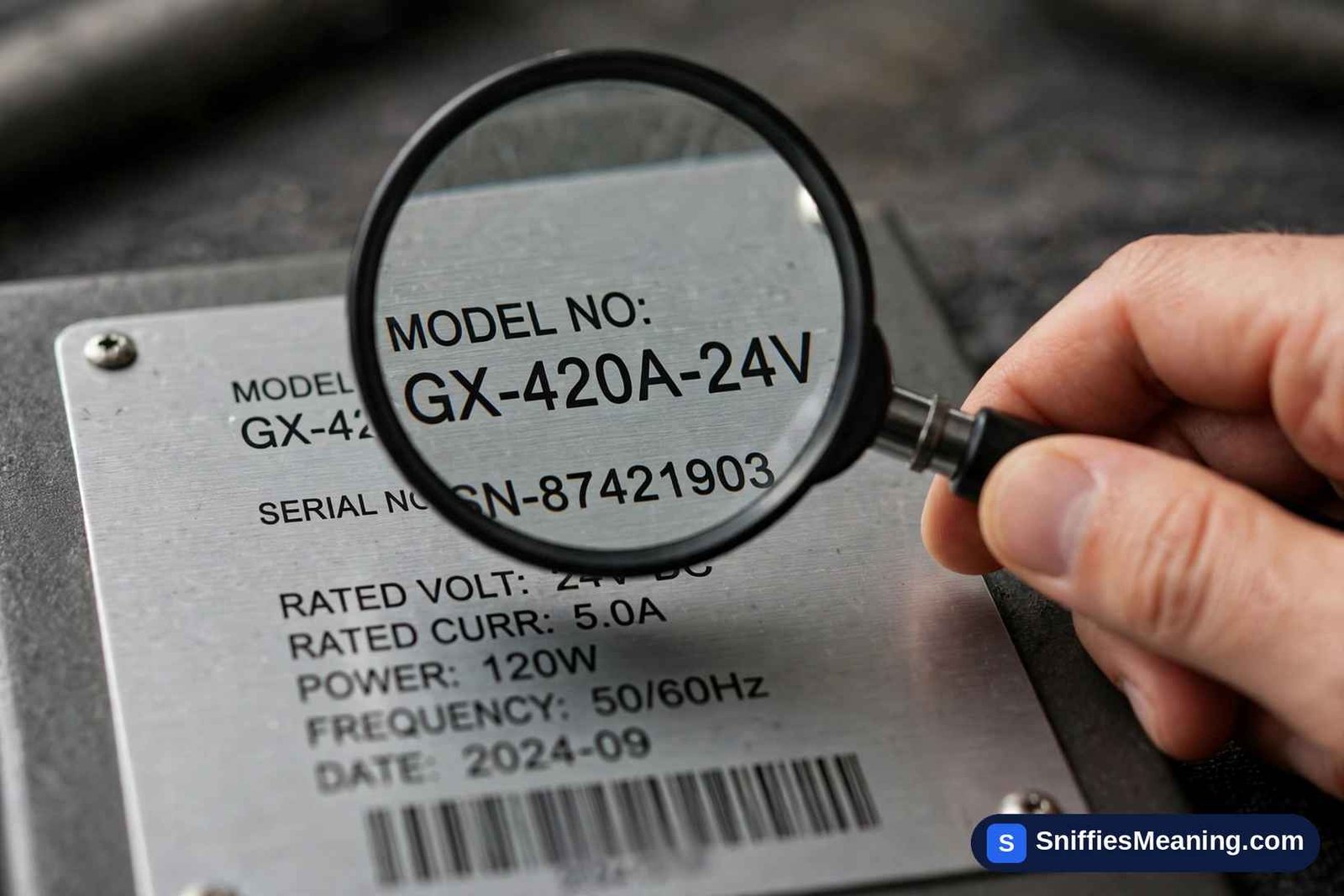
- Go back to the source. Where did the code appear — a label on a device, a board silkscreen, a manual, an invoice, a screenshot? Photograph the whole label or page, not just the code: the maker’s name, the device model and the neighbouring fields are what make a code searchable.
- Identify the device first. Find the host product’s maker and model from its own rating label. Makers’ support systems are organised by product, and a code that means nothing alone often resolves instantly inside the right product’s parts list.
- Search maker plus code together. A bare code searches the whole internet’s noise; the maker’s name plus the code searches one catalogue. If the maker’s own site still returns nothing, the code is most likely a serial, batch or internal reference rather than an orderable part.
- Check the manual’s parts section. Service and user manuals list replaceable parts with the numbers the maker actually sells. If your code is absent from that list, it was never a purchasable line.
- Ask the maker’s support, with the device serial number. Manufacturers identify parts from the unit’s serial and model, not from a stray code. A short message with a label photograph gets a definitive answer that no blog can give.
- Only then shop — by the confirmed number. Once support or the manual gives you the real MPN, the buying steps in the next sections apply to that number, and every check starts working: listings, prices, compatibility, returns.

Where Can I Find the Best Deal?
For this code, there is no deal to find, because there is no product to price. The figures attached to it online — $10–$50 for “asset packs” on one page, $200–$500 on another, $1,499–$2,499 on a third — are not competing offers; they are competing inventions, and the spread between them is the tell. Real parts have a market price because distributors publish one.
Once you have identified a genuine part number (the section above), the competitor’s deal-hunting advice becomes usable, with one correction of emphasis: compare authorised distributors first — Digi-Key, Mouser, RS and their regional equivalents publish real stock and real prices, and aggregators lay competing authorised offers side by side. Refurbished and surplus stock is a legitimate second tier for discontinued parts, from sellers who identify themselves, photograph the actual stock and accept returns. Price-comparison tools and restock alerts work on real listings; they cannot rescue a code that has none.
How to Verify Any Part Before You Pay for It
Whatever code brought you here, these five checks separate orderable parts from invented ones, and they take under an hour:
- Resolve the number. The exact part number must return the part — with a datasheet — on the manufacturer’s site or an authorised distributor’s. No datasheet, no order.
- Match the family. The number should sit inside the maker’s numbering scheme, surrounded by sibling variants. A number with no family is a number with no maker.
- Demand the documents. Ask the seller for the datasheet, the maker’s name and a photograph of the actual labelled stock. Refusal or stock photos of something else ends the conversation.
- Check the seller, not just the price. Authorised-channel status, a real business identity, published returns terms and payment methods with buyer protection. Anonymous checkout plus an unidentifiable code is the combination to walk away from.
- Price-sanity check. Genuine parts cluster around a market price across distributors. A lone offer far below — or far above — that cluster, for a part nobody else lists, is priced on invention.
Is 1.5F8-P1UZT Still in Production?
The question assumes a production line, and there is no evidence one ever existed. Production status is a fact a manufacturer publishes — active, not-recommended-for-new-designs, discontinued, last-time-buy — and no manufacturer publishes anything about this code. It is not that the item was discontinued; it is that no item has been shown to exist in the first place.
The secondary-market framing the competitor offers (surplus stock, warehouse overstock, custom fabrication) applies to identified parts that were once made and sold. Applying it here would repeat the founding mistake: you cannot hunt surplus stock of a thing that was never in a catalogue. If a maker ever does attach this code to a product, its status will appear in that maker’s system — which is, as everywhere in this article, the only place the answer can come from.
Conclusion
So, can i buy 1.5f8-p1uzt? On everything the checks could reach: no. The code belongs to no manufacturer, appears in no distributor’s inventory, has no datasheet, no manual, no listing and no price — and the pages that claim otherwise contradict each other on what it even is, describing a hardware part, a graphics texture format, an authentication protocol and a priced consumer device in turn. A string cannot be all of those, and the evidence says it is none of them.
The transferable skill is the checking itself. Identify the device before the code, resolve every number against its maker’s own system, demand the datasheet, and let authorised channels set the price. And when a component is genuinely scarce or discontinued, buy it through those channels anyway — scarcity is precisely where counterfeit electronic components enter the supply chain, remarked, recycled and cloned parts sold under genuine names. A code nobody can trace is an invitation to that market; a verified part number is the protection against it.
FAQs About Can I Buy 1.5F8-P1UZT
What does 1.5F8-P1UZT refer to?
Nothing verifiable. No manufacturer, distributor or database record matches the code, and the blogs that use it describe different things — a part, a texture format, a protocol — none with a source.
Can I buy 1.5F8-P1UZT on Amazon?
No. No Amazon listing exists for this code; searching it returns blog articles, not products. Any seller using the code cannot tie it to a maker or a datasheet.
Is 1.5F8-P1UZT a computer part?
That is one blog guess among several, and it is unverified. Other pages call the same string a graphics texture format or an authentication protocol, which is what invention looks like.
How do I find the exact 1.5F8-P1UZT part?
Start from where you saw the code: identify the device and its maker first, then search the maker’s name plus the code and check the device manual’s parts list. A bare code with no maker cannot be matched to a part.
Can I get support for 1.5F8-P1UZT purchases?
There is no official support, because no manufacturer stands behind the code. Only buy identified parts from sellers who provide documentation and accept returns.