Time Flies or Time Flys: What It Means, Where It Comes From, and Why ‘Flys’ Fails
Type time flies or time flys into a search box and you are really asking two questions at once: what does this old saying actually mean, and which of the two spellings deserves to survive your keyboard.
Only one spelling survives. The phrase runs as time flies — in headlines, in birthday cards, under graduation photographs — because flies is the shape the verb fly takes when its subject is a word like time.
What follows unpacks the saying itself: the picture hiding inside it, the Roman poet who launched it, the reason the years seem to accelerate, and the small spelling rule that settles the flys question for good.
Time Flies at a Glance
| Point | In short |
|---|---|
| What does it mean? | A stretch of time feels far shorter, looking back, than the clock said it was. |
| Which spelling is right? | Time flies — never time flys. |
| Where does it come from? | The Latin tempus fugit, from Virgil’s Georgics. |
| When do people say it? | At birthdays, reunions and endings — any look back over a vanished stretch. |
Those four rows hold the whole story in miniature. The rest of this page opens each one out.
What Does “Time Flies” Mean?
At its plainest, the saying reports a feeling: a period of time seemed to slip past far faster than it should have. An afternoon, a holiday, a childhood — the clock measured it honestly, yet in memory it sits compressed into almost nothing.
Merriam-Webster hands the verb fly a sense built for exactly this: “to seem to pass quickly,” illustrated by the sentence “The time simply flew.” Nothing is travelling through the air. The flight is a picture — time imagined as something winged, gone before a hand can close on it.
It keeps company with other compressed old sayings, takes one to know one among them: repeat it whole and it lands instantly, pull it apart word by word and the picture wobbles — hours do not grow feathers.
Said About More Than Fun
The saying is not reserved for pleasure. People say it over hospital waiting rooms that somehow ate a year, over a parent’s empty house, over a dog that was a puppy last spring.
Pleasure is only its most famous setting. The engine underneath is surprise: a stretch you expected to feel long turned out, in the remembering, to have been no stretch at all.
Where Does “Time Flies” Come From?
The saying is a translation. In Book 3 of the Georgics, his poem of farming life, the Roman poet Virgil breaks off a passage about animals in spring to warn that “fugit inreparabile tempus” — time, once fled, can never be got back.
Shortened to tempus fugit — literally “time flees,” since the Latin verb speaks of fleeing rather than flying — the phrase escaped the poem and took on a second life of its own.
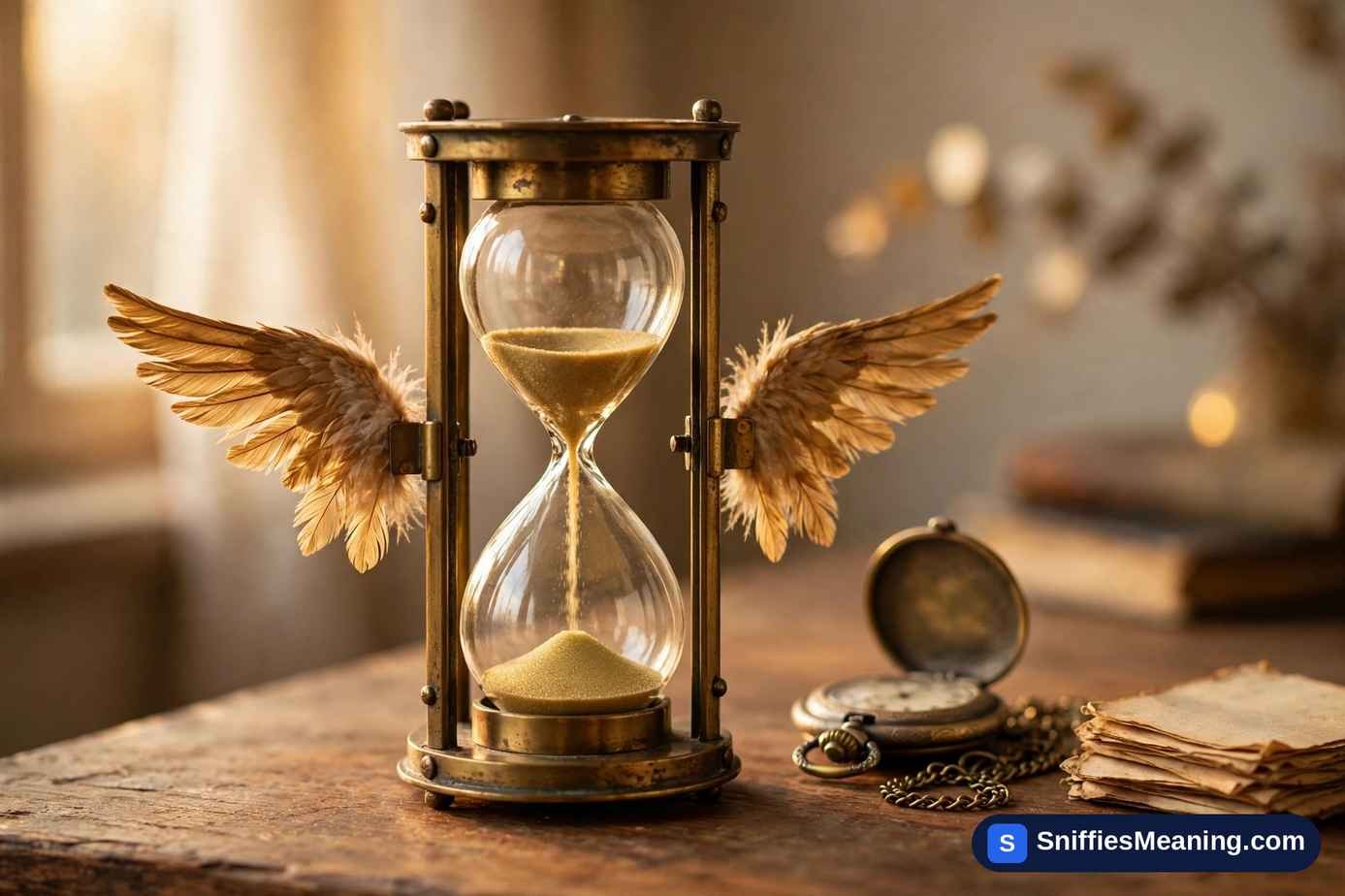
Clockmakers and stonecarvers adopted it as a motto. It still stares down from sundials and old clock faces, and the winged hourglass carved above gravestones is the same warning drawn as a picture instead of a sentence.
Flies, Not Flys: The Spelling Verdict
Grammar settles the spelling in one move. Fly works here as a verb, and with a third-person subject — he, she, it, or time — a verb whose last two letters are a consonant and a y trades that y for i and adds es. Fly becomes flies, exactly as try becomes tries and cry becomes cries.
Flys never gets a turn as a verb, in any tense, in any dialect. The full side-by-side — the rule stated formally, the look-alike traps, and more worked sentences — is set out in this guide to time flies or time flys.
British and American writers part company over colour and organise, but not over this: both write time flies, because the -ies pattern belongs to the verb system the two varieties share. It is the kind of pair Gimme Meaning was built for: two spellings, one survivor, and a rule short enough to remember.
The One Corner Where “Flys” Breathes
One fossil survives. Old dictionaries record flys as a plural noun for a vanished vehicle — the light horse-drawn carriage Victorians hired the way we hail a taxi. The Century Dictionary prints the plural of that carriage outright as “flys.”
That licence never reaches the verb. The moment fly is doing something — soaring, fleeing, hurrying past — its third-person form is flies, and a carriage plural from the 1890s cannot rescue “time flys” inside a sentence about hours.
Why Time Seems to Run Faster Every Year

The saying survives because the feeling underneath it is real, and two explanations are usually offered. The first is arithmetic: at ten years old, a single year is a tenth of everything you have lived; at fifty, the same twelve months are a fiftieth — a far thinner slice of the whole.
The second explanation lives in memory. Routine days leave almost no trace behind, so a month of identical commutes collapses, in hindsight, into one grey smear — while a single crowded holiday, dense with firsts, stays wide and detailed.
That is why the phrase blooms at endings: the last morning of a trip, a child suddenly taller than the pencil marks on a doorframe, a farewell card circulating an office. The novelty has run out, and the vanished stretch suddenly shows its speed.
Time Flies in Modern Speech and Captions
In daily life, the phrase does heavy social work. It is the caption under the school photograph, the toast at the retirement dinner, the message sent to an old friend after a silence of years: a small, shared gasp at the calendar.
English keeps a whole toolkit of set phrases for handling stretches of time — whole day or all day argues over duration from another drawer of it — and time flies is the tool reserved for the stretch that vanished while nobody was watching.
In chats it often travels shortened or decorated — “time flies 😭” under a baby photo, “time flies fr” in a group thread — but the two words at its centre never change shape, and never take a y.
The “Having Fun” Tail
The saying’s most quoted shape carries a tail — “when you’re having fun” — and the tail names the mechanism. Absorption is the engine: attention parked fully on the moment leaves none spare for watching the clock, so the hours go uncounted.
The tail also gets used with a wink, in places where fun is scarce: a dentist’s waiting room, a delayed train, a Monday meeting entering its third hour. Said flatly there, it means the opposite — and everyone in earshot understands the joke.
Strip the tail away and the bare two words do the reflective work. Said over old photographs or an emptied classroom, time flies carries a small ache that the fun version never attempts.
The Words Around It
| Expression | What it adds |
|---|---|
| tempus fugit | The Latin original — time fleeing, beyond recall |
| time flies by | The same flight, with the passing underlined |
| how time flies! | The exclamation form, for reunions and milestones |
| time flies like an arrow | The simile form — fast, straight and unstoppable |
The arrow line has a famous parasite. Linguistics classrooms treasure the sentence “Time flies like an arrow; fruit flies like a banana,” where the word flies flips from verb to insect halfway through — a joke often pinned on Groucho Marx, though The Yale Book of Quotations finds no evidence he ever said it.
Examples of Time Flies in Sentences
- “Can’t believe you’re graduating already — time flies.”
- “We checked in on Friday and somehow it is Sunday night; time flies on the coast.”
- “Ten years at this desk. Time flies when the work keeps changing.”
- “She opened the photo album and said it before anything else: ‘Time flies.'”
- “The twins start school in September — time flies faster every year.”
Frequently Asked Questions About Time Flies
Time flies or time flys — which one?
Always time flies. Flies is the third-person form of the verb fly, built by the consonant-and-y rule, and flys is not a verb form in any standard variety of English.
What does time flies mean?
It means a period of time felt far shorter than it really was — an afternoon, a holiday or a whole childhood seeming to vanish almost as soon as it had begun.
Where does the “having fun” ending come from?
It is a tail added to the older saying, and it names the mechanism: when attention is fully absorbed, nobody is watching the clock, so the hours seem to sprint.
Is time flys ever correct?
Only as a museum piece: old dictionaries list flys as the plural of a noun naming a horse-drawn carriage. As a verb — the job it does inside this phrase — it is never correct.
What is tempus fugit?
Latin for “time flees.” It comes from Virgil’s Georgics, where the full line warns that time, once fled, cannot be recovered; it later became a motto carved on clocks and sundials.
Conclusion
Time flies is a two-word act of disbelief: the clock insists the stretch was long, and memory insists it was nothing. The spelling is the easy half of it — flies, always, because the verb’s y turns to i before its ending.
The Romans set the warning as tempus fugit over their dials, and two thousand years later it remains the caption people reach for when a child, a job or a summer ends ahead of schedule.