Sports Harmonicode: What Harmonicode Sports Claims and What Checks Actually Show
If you have seen the term harmonicode sports on training blogs and want to know what it is, here is the honest short answer: it is a name blogs use for a claimed method of improving athletic performance with harmonic frequencies — but no official product, company, certification, published study or sports body behind that name can be verified anywhere. Every description of it traces back to blog posts, and those blogs do not even agree with each other about what it is.
That disagreement is the first clue. One set of blogs describes sports harmonicode as frequency and sound-wave therapy. Another describes “Harmonicode Sport” as an AI-powered analytics platform with subscription pricing. A third describes a biomechanics system of sensors and motion analysis. A real, established method does not change its basic identity from page to page — an invented label does.
This article separates the claim from the record: what the blogs say sports harmonicode is and how it supposedly works, what our checks actually found, what the genuine sports science underneath the buzzwords (vibration therapy, biomechanics, rhythm in movement) really supports, and how to check any performance claim before you pay for it.
Sports Harmonicode Profile Biographie Table
| Attribute | Details |
|---|---|
| Name | Sports Harmonicode (also written “Harmonicode Sport” and “Harmonicode Sports” on different blogs) |
| Category | Blog coverage files it under “Sports Science / Performance Enhancement” — no recognised sports-science category, registry or governing body lists it |
| Core Concept | Blogs claim the use of harmonic frequencies to improve physical and mental athletic ability — a claim repeated between blogs, not a documented method |
| Popular In | Blog copies claim the USA, Japan, Germany and South Korea — no survey, organisation or publication supports this |
| Applications | Claimed: muscle recovery, injury prevention, focus training, energy alignment — none is documented in any study we could find |
| Technology Used | Blog lists name harmonic resonance devices, wearables and sound wave therapy — no named product from any identifiable maker could be found |
| Adoption | Blog copies claim elite athletes, sports psychologists and physiotherapists — no named athlete, team or clinic appears in any checkable record |
| Benefits | Claimed: enhanced performance, faster recovery, reduced fatigue — unverified; the real research on vibration and recovery is summarised later in this article |
What Our Checks on Sports Harmonicode Actually Found
We checked this name the way a careful athlete or coach would: looking for an official website or company behind it, a product or app that can actually be bought or downloaded, a certification a “specialist” could hold, a published study, and any mention by a sports authority, team or reputable news outlet. The result is consistent: the name exists only inside blog content.
What exists: a cluster of blog explainers, all published on general content sites, describing “sports harmonicode” in glowing terms. Crucially, they contradict one another on the basics. The competitor page behind this search describes sound waves and vibrational energy delivered by devices. Other blogs describe an AI analytics platform that collects biometric data and charges a monthly subscription — one even prints pricing tiers. Others still describe a sensor-based biomechanics system for analysing stride and swing. None of these versions names a founder, a company address, a registered product, a study, or a single verifiable user.
What does not exist: any official site for the method, any app-store listing, any certification body, any listing in a sports-medicine journal or trial registry, and any coverage by a sports federation, Olympic body, university or news organisation. The dramatic statistics in the blog coverage — percentage drops in injuries, faster recovery figures, unnamed university laboratories — are never attached to a checkable source.
It is the same shape as our check of the why kiolopobgofit important term: a confident, technical-sounding label, pages of polished explanation, and nothing underneath that a reader can independently confirm. Even the word “harmonicode” itself has no settled meaning elsewhere — its oldest traceable use is a fictional constructed language described on a worldbuilding wiki in 2017, and its other appearances are generic blog essays using it as a metaphor for harmony in code and design. There is no harmonicode product in any field that we could verify.
None of this means the underlying ideas are all nonsense. Vibration, rhythm, sound and movement analysis are real topics in sports science — they are simply real under their own names, with real evidence and real limits. The sections below keep the blog claims and the verified picture clearly separated.
What Is Sports Harmonicode?
As the blogs present it, sports harmonicode is an integrative method that uses harmonic frequencies — usually described as sound waves or vibrational energy — to help athletes reach peak performance. The claim is that applying the right frequencies can support balance, strength, coordination and mental sharpness.
Read that paragraph for what it is: a description of a claim, written in the confident tone these pages use. No organisation publishes this definition, no textbook contains it, and no two blogs define the method in quite the same way. It is best understood as a label for an idea — that frequency and rhythm matter in the body — rather than the name of an established technique you can book, buy or study.
How Does Sports Harmonicode Work?
According to the blog version, the process involves specialised devices or software that emit controlled frequencies. These vibrations are said to interact with the athlete’s body, promoting natural healing, reducing inflammation and increasing stamina, with sessions customised to the individual and their sport.
What cannot be confirmed is any part of the delivery: no named device, no published protocol, no frequency table, no dosage standard and no practitioner directory exists for a reader to inspect. Real therapies that use physical energy — ultrasound in physiotherapy is one example — come with named equipment, clinical guidelines and licensed practitioners. Sports harmonicode, as described, comes with none of those anchors.
Key Benefits of Sports Harmonicode for Athletes
The blogs credit the method with a long list of benefits. The two headline claims are:
1. Improved Recovery Time — athletes using sports harmonicode are said to heal faster from injuries and recover muscle quicker after hard training sessions.
2. Enhanced Focus and Clarity — the technology is also said to stimulate brainwave activity, aiding mental clarity and reducing performance anxiety.
Both claims are presented without a single named study, athlete or clinic behind them. Faster recovery and better focus are exactly the benefits every recovery product promises, which is why they need evidence rather than repetition: the honest position is that these are marketing claims attached to a label, not measured results. What vibration research genuinely shows about recovery is covered in the evidence section below — and it is considerably more modest.
The Science Behind Sports Harmonicode
The blog explanation says the method is “rooted in quantum biology and frequency therapy,” and that each organ and muscle has a natural resonant frequency which the harmonicode “retunes,” like tuning a musical instrument.
This is the point where the language of science is used without the substance of it. “Quantum biology” is a real research field, but it studies quantum effects in processes like photosynthesis and enzyme activity — it does not provide a basis for retuning muscles with sound. The idea that every organ has a single resonant frequency that therapy can adjust is a staple of alternative-medicine marketing, not a finding of anatomy or physiology, and no paper demonstrating it for athletic performance could be found. A useful rule of thumb: when an explanation name-checks quantum physics, energy fields and tuning all at once, but cites nothing, it is borrowing credibility rather than presenting it.
What the Real Science Actually Supports: Vibration, Rhythm and Recovery
Strip away the label and there are real, researched ideas underneath — under their own names, with honest limits:
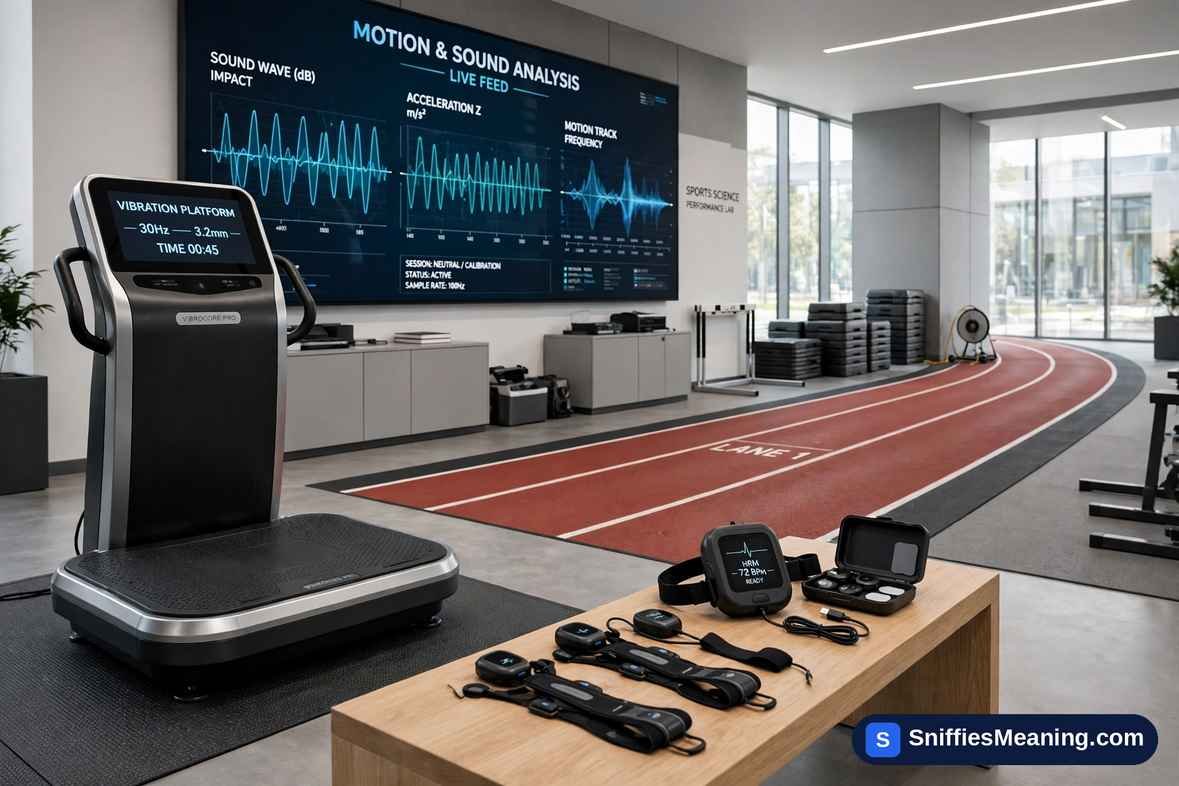
- Whole-body vibration (WBV) is a real modality. Athletes stand or exercise on a vibrating platform, and it has been studied in proper trials and meta-analyses. The fair summary is modest: small improvements in lower-body strength and power, mostly in untrained or older adults; some short-term relief of perceived muscle soreness; and several well-run studies finding no recovery benefit at all. It is a minor supporting tool in some gyms and clinics — not a performance breakthrough, and nothing like the sweeping claims made for “harmonicode.”
- Biomechanics and motion analysis are real. Wearable sensors, force plates and motion capture genuinely are used by professional teams and universities to measure stride, symmetry and load. That real technology is sometimes what the vaguer blog versions of “harmonicode” are gesturing at — but it is delivered by named companies and sports-science departments, under the name biomechanics.
- Rhythm and cadence are real coaching variables. Stride rate in running and pedal cadence in cycling are measured and coached every day. Music and rhythmic cueing also have genuine, if modest, research support for pacing and perceived effort.
- Sound-based products are mostly wellness products. Binaural beats and sound-therapy apps exist and are sold for relaxation and focus, with limited and mixed evidence — and none of them is a certified athletic method.
So the honest answer to “is any of this real?” is: the ingredients exist in real sports science, in weaker and more specific forms. The branded method assembled from them does not, so far as any public record shows.
Real-World Applications of Sports Harmonicode
The blogs describe two main uses:
1. Pre-Game Warm-Ups — sessions before competition, said to prime body and mind for optimal output.
2. Post-Training Recovery — sessions after workouts, said to reduce soreness and fatigue and speed the return to training.
These are descriptions of how the method would be used if it existed as described. Warm-ups and recovery sessions are, of course, real parts of training — every serious athlete does both, with established methods: dynamic warm-ups, strength work, sleep, nutrition, and physiotherapy where needed. What we could not find is any documented case — a named team, athlete, clinic or event — of a “sports harmonicode session” being delivered to anyone.
Devices and Tools Used in Sports Harmonicode’s
The blog lists of tools include:
- Bio-frequency pads
- Resonance wristbands
- Smart harmonic apps
- Vibration sound mats
These tools are described as delivering subtle vibrations or tones that sync with the body’s frequencies. In practice, we could not find any of them sold under the sports harmonicode name by an identifiable company: there is no product page, manual, price list or safety certification for a “harmonicode” device anywhere. Generic versions of some items certainly exist — vibration platforms are real products (see the evidence section), and resonance wristbands are a long-standing wellness-market item with no established effect — but a reader shopping for the named system will find only blog articles describing it, never the thing itself. That gap between description and availability is one of the clearest signs of an invented product category.
Who Can Benefit from Sports Harmonicode’s?
The blogs say the approach is not limited to elite athletes — that anyone active, from marathon runners to yoga practitioners, can benefit, and that coaches, therapists and wellness centres are beginning to adopt it.
Because the method itself is unverified, the honest answer to “who can benefit” is that nobody can be shown to have benefited from sports harmonicode specifically — there are no documented users. What people at every level genuinely can benefit from is the real content hiding under the buzzwords: structured training, coached technique, adequate sleep and nutrition, and, where a qualified physiotherapist recommends it, established recovery modalities such as vibration platforms used within their evidence limits.
Sports Teams and Organizations Using It
The competitor page states that elite football clubs in Europe, Olympic training centres and martial arts academies in Asia “are known to incorporate” sports harmonicode, and that testimonials from world-class athletes validate it.
We checked for any of this. No club, training centre, academy or athlete is named — on that page or anywhere else — and no testimonial from any identifiable athlete could be found. Phrases like “are known to” and “elite clubs” without a single name attached are doing all the work. Real performance methods used by real teams are easy to document: teams publish their sports-science partnerships, and companies name their clients. The complete absence of one verifiable name, across every blog covering the topic, is itself the finding.
Is Sports Harmonicode’s Scientifically Validated?
The blogs answer this with “research is ongoing” and references to “preliminary studies” supporting improved recovery, reduced cortisol and enhanced coordination, with double-blind studies “expected in the near future.”
Translated into checkable terms: no study is named, no journal is cited, no author, university or trial registration is given, and searches of the published literature return no paper on “sports harmonicode” at all. A claim that unnamed preliminary studies support a method is not validation — it is the appearance of validation. As of this writing, sports harmonicode has no scientific validation that a reader can inspect, and the correct description of its evidence base is: blog assertions only.
How to Check Any Sports Performance Claim Before You Pay
Sports harmonicode is a useful case study, because the same checks expose most over-claimed training products. Before spending money on any method, device or programme, run through these:
- Find the organisation. A real method has a company, institute or governing body with a name, an address and a history. If the only sources describing it are blogs — especially blogs that disagree about what it is — treat it as unverified. This is the same registry-and-record check we ran on the teckaya construction equipment ltd management name: when no official record exists behind a confident label, the label is the whole product.
- Demand named evidence. Real validation names the study, the journal, the authors and the year. “Studies show” with no citation is marketing, not science.
- Look for the product. A real device can be bought from an identifiable maker, with a manual, specifications and safety certification. If you can find articles about a device but never the device, stop.
- Check the credential. “Certified specialist” should mean a certificate issued by a body you can look up. If the certifying organisation itself cannot be found, the credential is decorative.
- Search for named users. Teams and athletes who use a method are normally publicised by the seller. Anonymous “elite clubs” are a red flag.
- Compare with the established alternative. For recovery and performance, physiotherapists, strength coaches and sports-medicine clinicians work with methods whose evidence and limits are published. Ask what the new claim adds beyond them — and what it would replace.
Limitations and Challenges of Sports Harmonicode’s
The blogs concede the method is “not yet universally accepted,” that critics want more empirical evidence, and that it should be combined with conventional training and recovery.
That understates the position. The limitation is not that acceptance is incomplete — it is that the basic record a method needs (an owner, a product, a protocol, a study, a user) is missing entirely. The challenge for a reader is different from the one the blogs describe: not “should I add this to my training?” but “is there anything here to add?” Until someone publishes verifiable evidence under this name, the responsible use of sports harmonicode content is as a prompt to explore the real topics — vibration therapy, biomechanics, recovery science — through sources that can be checked.
How to Get Started With Sports Harmonicode’s
The blogs advise consulting a “certified sports harmonicode specialist” who will assess you and recommend personalised sessions, and say most major cities now have clinics offering the service.
We could not verify that any such specialist or clinic exists: there is no certification to check and no directory to consult, and searches for practitioners return the same blog articles. So the practical “getting started” advice is different. If the underlying ideas interest you — vibration work, movement analysis, recovery support — start with people whose credentials are real and checkable: a physiotherapist, a strength and conditioning coach, or a university sports-science clinic. They can tell you which of the real modalities, if any, suit your situation, and their qualifications can be verified before you pay anything.
Future of Sports Harmonicode’s in Athletic Training
The blogs predict the method will become more precise and data-driven as wearable technology and AI evolve, ending as a staple of next-generation training.
Wearables and AI genuinely are transforming athletic training — through biomechanics, load monitoring and performance analytics, delivered by identifiable companies and research groups. If “sports harmonicode” has a future, it is most likely as a label that keeps circulating in blog content, attaching itself to those real advances. Readers should expect the phrase to keep appearing; they should also keep asking the questions in the checklist above, because the arrival of more blog posts about a name is not the arrival of evidence for it.
Why Names Like Sports Harmonicode Keep Circulating
If nothing verifiable sits behind the name, why do pages about it keep appearing — and why does it get searched at all? The mechanics are ordinary. Athletes and coaches constantly search for recovery and performance edges, which creates demand for content about any promising-sounding term. Content sites supply that demand by writing confident explainers around the term, each new article borrowing the tone of the last, until repetition itself starts to look like evidence: the name appears everywhere, so it feels established.
The practical lesson is to weigh sources, not volume. Ten blog posts repeating one another count as one unverified claim, not ten confirmations. A single record from the other side of the ledger — a registered company, a published study, a named team, a product you can actually buy — would outweigh all of them, and for sports harmonicode, that record has yet to appear.
Conclusion
Sports harmonicode is presented online as a revolutionary frequency-based training method, but every check leads to the same place: blog pages describing it, disagreeing about what it is, and offering no company, product, study, specialist or user that anyone can verify. The honest answer to the search behind harmonicode sports is that the method, as a real and purchasable thing, cannot be shown to exist.
The ideas it borrows from are real, and they are worth your time under their real names: whole-body vibration with its modest, mixed evidence; biomechanics and wearable analysis as practised by actual sports-science teams; rhythm and cadence as ordinary coaching variables. If you take one thing from this page, take the checklist — because the difference between a breakthrough and a buzzword is exactly the difference that sports science exists to check.
FAQs About Sports Harmonicode
Q1: Is sports harmonicode safe for all athletes?
There is no defined method whose safety can be assessed — no protocol or product exists to test. Real vibration devices do carry cautions (including for people with pacemakers), so treat any frequency device as a medical product and ask a doctor first.
Q2: How long is a typical sports harmonicode session?
The 20–45 minute figure comes only from blog descriptions of the claim; no standard exists. No provider publishes an actual session protocol that can be checked.
Q3: Does sports harmonicode require professional supervision?
There are no certified specialists to supervise it — no certifying body could be found. The real modalities it borrows from are delivered by physiotherapists and coaches with verifiable qualifications.
Q4: Can children or teen athletes use it?
No verified programme exists for athletes of any age. Parents should stick to qualified coaches and clinicians, and be especially wary of paid “systems” marketed for young athletes without published evidence.
Q5: How quickly can results be seen?
No measured results have been published anywhere, for any timeframe. Claims of improvements “after a few sessions” appear only in blog copy, unattributed to any user or study.
Q6: Is this method recognized by sports authorities?
No. We found no mention of sports harmonicode by any sports federation, Olympic committee or national sports body — the blog claim that some bodies “acknowledge its use” names none of them.
Q7: Can sports harmonicode replace physiotherapy?
No — on this point the blogs are right, if understated. Physiotherapy is a regulated profession with published evidence; an unverified label cannot replace it, and injuries belong with a clinician.