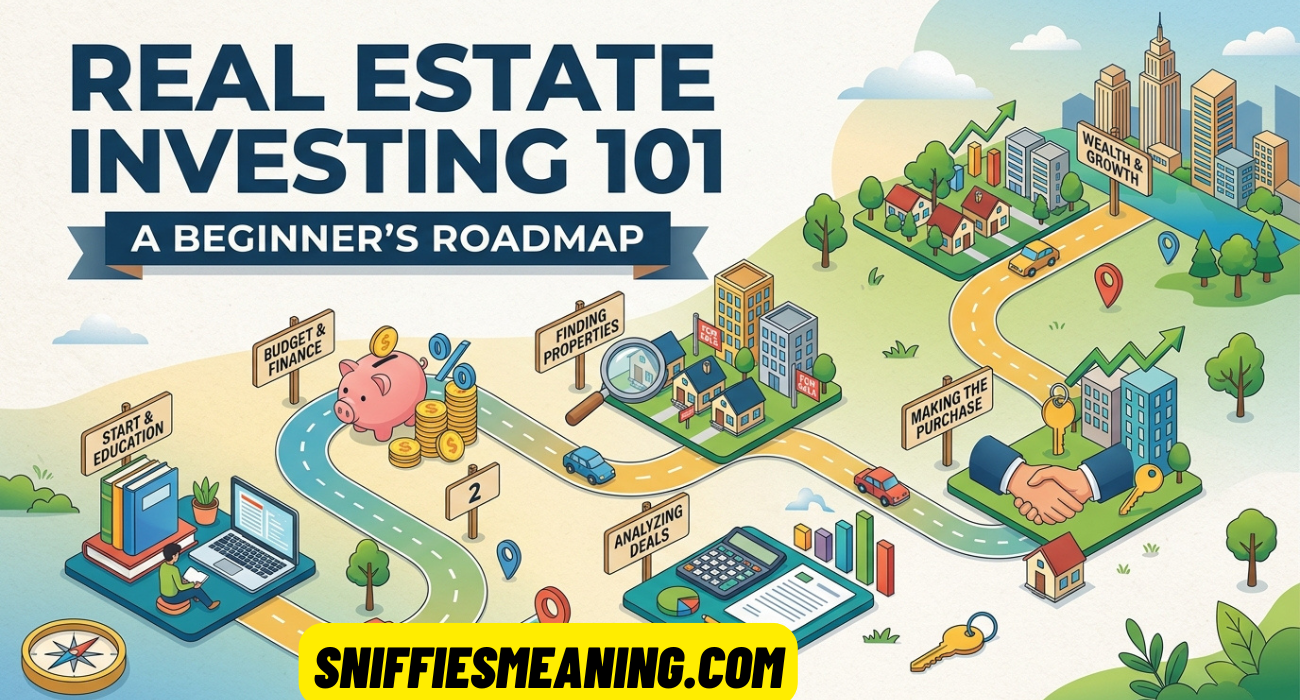
Real Estate Investing 101: A Beginner’s Roadmap
Real estate investing can help you build long-term wealth, earn rental income, and diversify your investments. However, success requires more than buying a property and waiting for its value to rise. You need to understand the market, calculate expenses, choose suitable financing, and prepare for unexpected costs.
Whether you want to purchase your first rental home, invest in commercial property, or explore real estate investment trusts (REITs), a clear plan can help you make informed decisions. This guide explains the main types of real estate investments, how to evaluate opportunities, where to find financing, and how to get started with a manageable level of risk.
Understanding Real Estate Investing

Real estate investing means purchasing, owning, managing, or financing property to earn income or increase your wealth over time. Investors may make money through rent, property appreciation, business operations, or the eventual sale of an asset.
Unlike some investments that you can sell with a few clicks, physical real estate often requires substantial upfront capital and ongoing management. You may need to arrange financing, inspect a building, handle repairs, find tenants, and pay taxes. The potential rewards can be attractive, but they depend on the property’s price, location, operating costs, and market conditions.
Read Also : Pedro Vaz Paulo: Essential Business Strategies That Doubled Client Profits
Basic Concepts of Real Estate
Before investing, learn the basic terms that describe property ownership and financial performance.
Cash flow is the money left after collecting rental income and paying operating expenses and debt payments. Positive cash flow means the property generates more cash than it consumes during the period measured.
Appreciation refers to an increase in a property’s market value. It can improve your wealth, although appreciation is never guaranteed and does not necessarily provide spendable cash until you sell or borrow against the property.
Equity is the difference between a property’s market value and the outstanding debt secured by it. Your equity may grow when you repay mortgage principal or when the property appreciates, but it can also decline if the market value falls.
Return on investment (ROI) measures the gain or loss relative to the amount invested. Investors also use capitalization rate, commonly called the cap rate, to compare income-producing properties.
For example, suppose a rental home earns $24,000 in annual rent and has $9,000 in annual operating expenses. Its net operating income (NOI) is $15,000 before mortgage payments, income taxes, and certain other costs.
If the property costs $200,000, its cap rate is 7.5%.
\[ \text{Cap Rate}=\frac{\$15,000}{\$200,000}\times100=7.5\% \]
This calculation is a starting point, not proof that the property is a good investment. You must still consider financing, repairs, vacancies, future expenses, and the accuracy of the income estimates.
Why Invest in Real Estate?
Real estate attracts investors because it can provide several potential sources of return. However, the benefits depend on the strategy and the property’s performance.
- Rental income: A tenant may provide recurring income that helps cover operating expenses and financing costs.
- Long-term appreciation: Property values may rise as demand grows, infrastructure improves, or the local economy expands.
- Equity building: Mortgage principal repayment can increase your ownership stake over time.
- Portfolio diversification: Property investments may behave differently from stocks and bonds, although real estate is not immune to broader economic downturns.
- Potential tax advantages: Eligible investors may qualify for deductions or other tax treatments, depending on their jurisdiction and circumstances.
- Control over the asset: Direct owners can make decisions about improvements, rents, management, and when to sell, subject to applicable laws and contractual restrictions.
These benefits do not come automatically. A vacant property can lose money, a major repair can erase months of rental income, and rising borrowing costs can make a previously attractive investment unprofitable.
Common Misconceptions
One common misconception is that real estate always increases in value. Property markets can decline because of higher interest rates, weaker employment, oversupply, changing neighborhood conditions, or reduced buyer demand.
Another misconception is that rental income equals profit. Rent is only the starting point. Owners must account for maintenance, insurance, property taxes, vacancies, management fees, utilities they cover, and other operating costs.
Some beginners also assume that they must buy a whole house to enter the market. In reality, depending on your country and available financial products, you may be able to invest through publicly traded real estate investment trusts, real estate funds, or professionally managed investment arrangements.
Finally, borrowing more money does not automatically improve returns. Leverage can magnify gains when a property performs well, but it can also magnify losses and make payments difficult when rental income falls.
Types of Real Estate Investments
Different property types serve different investment goals. Some focus on steady rental income, while others depend more heavily on development, business activity, or future appreciation.
The right choice depends on your available capital, experience, risk tolerance, investment timeline, and willingness to manage property.
Residential Real Estate
Residential real estate includes single-family homes, apartments, condominiums, duplexes, and other properties designed for people to live in.
Many beginners consider residential rentals because they can research comparable rents, study local housing demand, and start with a relatively straightforward property. An owner might purchase a small house, rent it to a household, and use the rental income to cover expenses.
Another strategy is house hacking. An investor lives in one part of a property and rents out another unit or room, where local rules and the property’s layout permit it. This can help offset housing costs, but it still requires careful budgeting and respect for tenant rights.
Residential investing also carries challenges. Tenants may leave unexpectedly, repairs can be expensive, and local rental laws may restrict rent increases, deposits, or eviction procedures. Short-term rentals introduce additional considerations, including licensing, seasonal demand, and platform fees.
Commercial Real Estate
Commercial real estate generally includes properties used for business purposes, such as offices, retail centers, hotels, and certain mixed-use buildings.
Investors may earn rental income from businesses operating in these spaces. Some leases also require tenants to cover certain property expenses, depending on the lease structure. Longer leases can offer income visibility, but a single tenant leaving may create a substantial vacancy.
Commercial properties require careful analysis of tenant quality, lease terms, operating costs, financing, and local business demand. For example, an office building may struggle if employers reduce their physical workspace, while a well-located retail property may face competition from online shopping or changing consumer habits.
This category may suit investors with greater capital, relevant expertise, or access to experienced partners. Commercial real estate is not automatically more profitable than residential property.
Industrial and Land Investments
Industrial real estate includes warehouses, distribution centers, manufacturing facilities, and other properties used for storage, production, or logistics. Demand can depend on transport access, supply chains, business expansion, and the availability of suitable buildings.
Land investing involves purchasing undeveloped or underdeveloped plots in anticipation of future use or appreciation. Investors may hold land, seek planning approval, or prepare it for development.
Both strategies require detailed due diligence. Industrial properties may need specialized infrastructure, while vacant land may produce no income and still incur taxes, maintenance, or financing costs.
Before purchasing land, verify legal ownership, zoning, permitted uses, access rights, utility availability, environmental restrictions, and development requirements. Never assume that a plot can be built on simply because nearby properties have been developed.
Real Estate Investment Trusts and Funds
Real estate investment trusts (REITs) allow investors to gain exposure to income-producing real estate without directly purchasing an entire building. A REIT may own apartments, warehouses, healthcare facilities, shopping centers, or other property assets. Some REITs also invest in real estate debt.
Publicly traded REITs can generally be bought and sold through a brokerage account during market trading hours. This makes them more accessible and often easier to sell than an individual property. However, their share prices can fluctuate considerably, and dividends are not guaranteed.
Private real estate funds and crowdfunding platforms may allow investors to participate in larger projects with other investors. These arrangements vary in their fees, minimum investments, transparency, investor protections, and ability to withdraw money.
Before investing through a fund or platform, review its legal documents, management fees, borrowing practices, property valuations, exit terms, and potential conflicts of interest. Confirm that the offering and its providers comply with applicable securities laws.
Evaluating Real Estate Market
A property’s location influences its rental demand, resale potential, operating costs, and exposure to local risks. However, a promising neighborhood does not guarantee a profitable investment. You must assess both the market and the individual property.
Market Research
Start by examining the local housing or commercial property market. Gather information from several reliable sources rather than relying on a seller’s claims or a single online listing.
Useful research includes comparable sale prices, rental listings, vacancy levels, property taxes, insurance costs, construction activity, and local employment trends. For residential property, also examine school access, transport links, amenities, and the condition of nearby homes where relevant.
Speak with local property managers, experienced agents, lenders, and contractors to understand costs that online listings may overlook. Verify key details independently whenever possible.
Most importantly, distinguish asking prices from completed sales. A property listed for $250,000 has not necessarily demonstrated that buyers will pay that amount. Recent comparable transactions usually provide a stronger starting point for estimating market value.
Identifying Growth Areas
Investors often look for areas where population, employment, transport, or business activity may support future property demand.
Potential indicators include new infrastructure, expanding employers, improving public transport, planned commercial developments, and a shortage of suitable housing. These signs can help identify opportunities, but they do not guarantee that prices will rise.
Check whether the expected growth is already reflected in property prices. A neighborhood can attract considerable attention while offering poor returns if investors pay too much upfront.
Consider risks as well. Flood exposure, water shortages, pollution, weak infrastructure, restrictive zoning, or dependence on one major employer may affect long-term demand and ownership costs.
Analyzing Market Trends
Track trends over time rather than making decisions based on a short burst of activity. Useful indicators include median sale prices, days on market, rental growth, vacancy rates, new construction, mortgage rates, and the balance between buyers and available properties.
Look at how these measures interact. For instance, rising rents may improve potential income, but rising purchase prices can reduce the yield earned on a new investment.
Review several possible scenarios before buying. Ask what would happen if rents stayed flat, insurance costs increased, repairs exceeded expectations, or the property took longer to sell than planned.
A property should make financial sense under reasonable, less favorable assumptions. If the numbers only work when every forecast goes perfectly, the investment may carry more risk than you can comfortably accept.
Financing Your Real Estate Investment
Financing affects how much money you need upfront, how much income remains after payments, and how vulnerable you are to unexpected expenses.
Before choosing a loan, determine your available cash, existing debt, credit profile, expected holding period, and ability to cover payments without relying on uninterrupted rental income.
Traditional Mortgages
A traditional mortgage allows you to purchase property using borrowed money and repay the loan over an agreed period. The property generally serves as collateral.
Mortgage options vary by country, lender, property type, occupancy, borrower qualifications, and local regulations. A loan for an owner-occupied home may have different requirements from a mortgage for a rental property or commercial building.
Compare the interest rate, loan term, required down payment, closing costs, monthly payment, insurance requirements, prepayment conditions, and whether the rate can change. A lower advertised payment does not always mean a cheaper loan.
For example, US borrowers can use a Loan Estimate to compare key mortgage terms and fees across lenders. The Consumer Financial Protection Bureau recommends reviewing the total payment and upfront costs, not just the interest rate.
Alternative Financing Options
Traditional mortgages are not the only way to finance a property. Depending on the jurisdiction and investment structure, alternatives may include:
- Private lending: An individual or private company lends money under agreed terms, often at a different cost or risk profile from a conventional mortgage.
- Partnerships: Two or more investors contribute capital, expertise, or other resources and share profits and losses according to a legal agreement.
- Seller financing: The seller allows the buyer to pay some or all of the purchase price over time under a formal financing agreement.
- Real estate crowdfunding: Multiple investors contribute funds toward a property or development through a platform.
- REITs and real estate funds: Investors purchase shares or fund interests rather than arranging a mortgage to buy a property directly.
Each method has trade-offs. Private loans may carry higher interest rates, partnerships can create disagreements, and crowdfunding investments may restrict withdrawals. Seller financing also requires careful review of ownership, existing liens, default rights, and enforceability.
Never accept informal promises as a substitute for written terms. Have a qualified legal or financial professional review complex agreements before committing funds.
Tips for Securing Loans
Lenders generally evaluate your ability to repay the loan, the property’s value, and the risk involved. Preparation can make the application process more straightforward.
Organize income records, bank statements, tax documents, details of existing debts, and information about the property. For a rental investment, prepare realistic estimates of rental income, vacancy, maintenance, insurance, and taxes.
Compare offers from multiple lenders where practical. Check the full borrowing cost, not just the monthly payment, and ask whether the rate is fixed or variable. Understand what happens if you sell early, refinance, or miss a payment.
Keep cash available after closing. Spending every available dollar on the down payment leaves little room for repairs, vacancies, or other unexpected expenses.
Loan approval also does not establish that a property is a sound investment. The lender is evaluating its own exposure, while you must determine whether the purchase supports your financial goals.
Steps to Begin Investing
A structured approach helps beginners avoid rushed purchases and focus on investments they can afford to hold through difficult periods.
Setting Investment Goals
Begin by defining what you want your real estate investment to achieve. You might prioritize monthly income, long-term appreciation, retirement planning, or a combination of these goals.
Your objective influences the type of property you should investigate. An investor seeking income may focus on rental demand and cash flow, while someone pursuing appreciation may study long-term development patterns and the local economy.
Set a realistic budget that includes more than the purchase price. Account for your down payment, transaction costs, inspections, initial repairs, ongoing expenses, and a reserve for emergencies.
Also establish a holding period and an acceptable level of risk. Physical property can take time to sell, so avoid investing money you may need immediately for essential expenses.
Building a Diverse Portfolio
Diversification means avoiding excessive dependence on a single investment or source of income. In real estate, this might involve owning different property types, investing across locations, or combining direct ownership with REITs or other assets.
However, diversification does not require buying several properties immediately. A beginner with limited savings may be better served by learning one strategy and building a stable financial foundation before expanding.
You should also consider your broader finances. Owning several rental homes in one neighborhood may appear diversified, but the investments could all suffer from the same local downturn.
Spread risk thoughtfully, and make sure you understand every investment before adding it to your portfolio.
Starting with Small Investments
You do not need to begin with a large apartment building or an expensive commercial property. Depending on your financial situation and local options, you may start by researching small residential rentals, purchasing shares in a publicly traded REIT, or learning how property partnerships operate.
Each route offers a different balance of control, cost, liquidity, and responsibility. Direct ownership gives you more control but demands more capital and management. Publicly traded REITs provide exposure to property markets without requiring you to manage tenants, although their prices can move with the stock market.
A sensible first step is to study several properties without buying any. Estimate income, calculate expenses, compare financing, and test how the numbers change when conditions worsen. This exercise builds practical judgment before you risk your savings.
How to Calculate Rental Property Profitability
Before making an offer, estimate whether the property can generate enough income to justify its cost and risks. A simple rental analysis can reveal problems that a property’s appearance or advertised rent might hide.
Start with gross rental income, then subtract expected operating expenses to calculate net operating income. Operating expenses may include property taxes, insurance, routine maintenance, management fees, owner-paid utilities, and an allowance for vacancy. Loan payments are not included in NOI.
Next, subtract mortgage payments and other relevant cash expenses to estimate cash flow before income taxes and any expenses not already included.
Consider this illustrative example:
| Annual rental calculation | Amount |
|---|---|
| Gross scheduled rent | $24,000 |
| Vacancy allowance | −$1,200 |
| Property taxes and insurance | −$4,000 |
| Maintenance and repairs | −$2,000 |
| Property management | −$1,500 |
| Other operating costs | −$1,300 |
| Net operating income | $14,000 |
| Annual mortgage payments | −$10,000 |
| Cash flow before income taxes | $4,000 |
In this example, the property produces $4,000 in annual cash flow under the stated assumptions. That is not a guaranteed return, and the calculation may need additional adjustments for major capital improvements, acquisition costs, and other property-specific expenses.
You can also estimate cash-on-cash return by dividing annual pre-tax cash flow by the total cash invested.
If the investor put $50,000 into the purchase and closing costs, the illustrative cash-on-cash return would be 8%:
\[ \frac{\$4,000}{\$50,000}\times100=8\% \]
This measure helps compare cash returns across leveraged property investments, but it does not capture every aspect of performance. It excludes potential appreciation and equity gains, and it can change substantially when rents, expenses, or financing costs change.
Use conservative estimates and compare several scenarios before deciding whether to proceed.
Essential Due Diligence Before Buying Property

Due diligence is the process of verifying a property’s legal status, physical condition, financial performance, and suitability before completing a purchase. It helps you identify problems that could otherwise become expensive surprises.
Read Also : Why PedroVazPaulo Business Consultant? Real Results From 10+ Years of Experience
Verify Ownership and Legal Documents
Confirm that the seller has the legal authority to transfer the property. Review title or ownership records, liens, easements, zoning rules, permits, lease agreements, and other documents relevant to the transaction.
Property laws and registration systems differ across jurisdictions. Use an appropriately qualified local lawyer or title professional to verify the records and explain any restrictions.
Inspect the Property
Arrange a suitable professional inspection before committing to a purchase where possible. Depending on the property, you may need specialists to assess the roof, foundation, electrical systems, plumbing, drainage, heating and cooling equipment, or potential environmental hazards.
Request estimates for significant repairs. A low purchase price may be less attractive once you account for structural damage, outdated systems, or required upgrades.
Verify Rental Income and Expenses
Check whether the proposed rent is realistic by reviewing comparable rentals and local demand. If tenants already occupy the property, verify leases, rent payment records, deposits, and any outstanding disputes.
Obtain actual or reliable estimates for taxes, insurance, maintenance, utilities, management, and other operating costs. Do not rely entirely on projections supplied by a seller who has a financial interest in the sale.
Review Insurance and Local Risks
Confirm that suitable insurance is available and affordable for the property’s location and intended use. Review risks such as flooding, wildfire, storms, crime, or other local hazards where relevant.
Check whether the property requires special coverage, whether exclusions apply, and whether the expected premium fits your budget. Insurance availability and pricing can change, so verify them before closing.
Risks of Real Estate Investing and How to Manage Them
Every investment carries risk, and physical property has several that beginners should understand before committing capital.
Market risk: Property values and rents may fall. Reduce your exposure by avoiding overly optimistic price forecasts and examining how the investment performs under weaker market conditions.
Vacancy risk: A rental unit may remain empty between tenants. Budget for periods without rent and avoid relying on full occupancy every month.
Unexpected expenses: Repairs, replacements, legal disputes, and insurance increases can reduce returns. Maintain an emergency reserve and plan for major components that may need replacement.
Interest-rate risk: Variable-rate debt may become more expensive when rates rise. Understand the loan’s terms and test whether your budget can absorb higher payments.
Liquidity risk: Selling a property can take time and involve substantial transaction costs. Avoid investing funds that you may need quickly.
Tenant and legal risk: Late payments, property damage, disputes, and changing regulations can affect income. Use lawful screening procedures, clear written leases, appropriate insurance, and qualified local advice.
Overleverage: Excessive borrowing can leave you unable to meet payments when income falls. Choose debt levels that leave room for unexpected costs and avoid assuming that refinancing will always be available.
One useful rule is to evaluate a property under a base case and a downside case. The base case uses reasonable estimates. The downside case assumes lower rent, more vacancy, higher costs, or a longer resale period. If the investment becomes financially unmanageable after a modest setback, reconsider the purchase.
Tax Considerations for Real Estate Investors
Taxes can affect the amount of money you keep from a property investment. The rules depend on where the property is located, how you own it, how you finance it, and whether the income comes from rent, a sale, or a fund distribution.
Depending on local law, eligible property owners may be able to deduct certain operating expenses, mortgage interest, or depreciation. A sale may trigger capital gains tax or other taxes, and some jurisdictions impose additional rules on rental income or property transfers.
For US investors, the Internal Revenue Service provides guidance on reporting rental income and expenses. However, eligibility and reporting requirements depend on the circumstances. Investors in other countries should consult their local tax authority or a qualified tax professional.
Keep accurate records of rental payments, repairs, insurance, property taxes, loan interest, improvements, and transaction costs. Separate personal and investment expenses, and retain receipts and supporting documents. Good recordkeeping makes it easier to measure profitability and prepare accurate tax returns.
Real Estate Investing Strategies for Beginners
Different strategies require different levels of money, experience, time, and risk tolerance. Understanding these differences can help you select an approach that matches your circumstances.
| Strategy | How it works | Main consideration |
|---|---|---|
| Buy-and-hold rentals | Purchase property and rent it over an extended period | Requires ongoing management and sufficient cash reserves |
| House hacking | Live in a property while renting out part of it | Occupancy rules, privacy, and tenant responsibilities matter |
| Property renovation | Improve a property and sell or rent it | Repair costs and resale values can be difficult to predict |
| REIT investing | Buy shares in a company that invests in real estate | Share prices fluctuate, and distributions are not guaranteed |
| Real estate partnerships | Invest alongside other people or entities | Agreements, fees, control, and exit rights need careful review |
| Land investing | Buy land for potential future use or appreciation | May generate no income and can be difficult to sell |
Buy-and-Hold Investing
Buy-and-hold investing involves purchasing a property and keeping it for an extended period. The investor may collect rent, benefit from potential appreciation, and gradually build equity by repaying mortgage principal.
This strategy requires a realistic understanding of long-term maintenance, tenant turnover, financing, and local rental demand. It works best as a planned investment rather than a bet that prices will inevitably rise.
House Hacking
House hacking allows an investor to reduce personal housing costs by renting out a room, separate unit, or another permitted part of a property.
For example, a buyer might purchase a duplex, live in one unit, and rent the other. The rental income may offset some of the mortgage and operating costs, but the owner remains responsible for expenses and tenant obligations.
Before using this strategy, confirm that the property, mortgage, insurance, zoning, and local rental rules allow the intended arrangement.
REIT Investing
REITs can provide a starting point for people who want exposure to real estate without managing a physical property. Publicly traded REIT shares can generally be purchased through a brokerage account, and some investors choose diversified REIT funds instead of individual companies.
Research the REIT’s property types, financial reports, debt levels, management, fees, and distribution history. Be cautious about unusually high advertised yields, especially when the investment is difficult to value or sell. The US Securities and Exchange Commission provides investor guidance on publicly traded REITs and their risks.
Common Mistakes to Avoid as a Beginner
A careful investment process can help you avoid several expensive mistakes.
Buying based on emotion. Attractive interiors, impressive marketing, or pressure from a seller can distract you from the financial numbers. Evaluate the property against your investment criteria.
Ignoring the full cost of ownership. Include closing costs, repairs, vacancies, management, taxes, insurance, and long-term maintenance. A property that looks affordable at first may require more cash than expected.
Overestimating rental income. Use comparable rents and account for periods without tenants. Do not assume that the property will always remain occupied or that rents will rise every year.
Skipping inspections or legal checks. Hidden defects and ownership problems can be costly. Verify property records and arrange appropriate professional inspections before closing.
Using all available savings. A large down payment may reduce borrowing, but exhausting your cash reserves leaves you vulnerable to unexpected expenses.
Relying on appreciation alone. Future prices are uncertain. Consider whether the investment remains financially manageable if its value stays flat for several years.
Failing to plan an exit. Decide what circumstances might lead you to sell, refinance, or change your investment strategy. Consider transaction costs, taxes, loan conditions, and the possibility that a buyer may not appear quickly.
A good investment process does not eliminate risk. It helps you recognize, measure, and manage risk before it threatens your financial stability.
FAQs
What is real estate investing?
Real estate investing involves buying, owning, financing, or investing in property to generate income or potential long-term gains. Common approaches include rental properties, commercial buildings, land, and real estate investment trusts.
How much money do you need to start real estate investing?
The amount depends on your investment method, location, financing options, and financial goals. Direct property ownership often requires a down payment, closing costs, and cash reserves. Publicly traded REITs may allow you to begin with the cost of a small number of shares, although brokerage minimums and fees vary.
Is real estate investing good for beginners?
Real estate investing can suit beginners who have realistic expectations, understand the risks, and prepare a financial plan. Starting with education, market research, and conservative calculations can help you avoid expensive mistakes. You do not need to purchase a property immediately to begin learning.
What is the most common way to make money from real estate?
Investors commonly earn money through rental income and property appreciation. Some also profit by renovating properties, developing land, or investing in real estate companies. The results depend on purchase price, expenses, financing, market conditions, and the investment strategy.
Is rental income guaranteed?
No. Rental income depends on tenants paying rent and the property remaining suitable for occupancy. Vacancies, missed payments, repairs, legal restrictions, and changes in local demand can reduce income. Investors should budget for these possibilities instead of assuming every month will produce a profit.
What is the difference between a REIT and a rental property?
A rental property involves direct ownership, which usually gives you greater control but also makes you responsible for management and expenses. A REIT lets you invest in a company that owns or finances real estate. Publicly traded REITs are generally easier to buy and sell, while direct property ownership usually requires more capital and effort.
How do you evaluate whether a rental property is profitable?
Estimate realistic rental income, subtract vacancy allowances and operating expenses to calculate net operating income, and then account for mortgage payments and other cash expenses. Compare the expected cash flow and return with your initial investment. Also test how the results change if rent falls or expenses rise.
What risks should beginners consider before investing in real estate?
Important risks include falling property values, vacancies, unexpected repairs, rising financing costs, legal disputes, and difficulty selling quickly. Investors should verify ownership documents, inspect the property, research the local market, and maintain adequate cash reserves before purchasing.
Conclusion
Real estate investing can offer opportunities to earn rental income, build equity, and pursue long-term financial goals. However, successful investing requires careful research, realistic financial calculations, suitable financing, and an understanding of the risks involved. Residential rentals, commercial buildings, land, and REITs each offer different benefits and responsibilities.
If you are a beginner, start by defining your goals, reviewing your finances, and studying your local market. Compare potential investments, calculate all ownership costs, and investigate legal and physical issues before committing your money. Avoid relying on guaranteed appreciation or overly optimistic rental projections. A patient, well-researched approach can help you make more informed decisions and build an investment strategy that fits your financial situation.