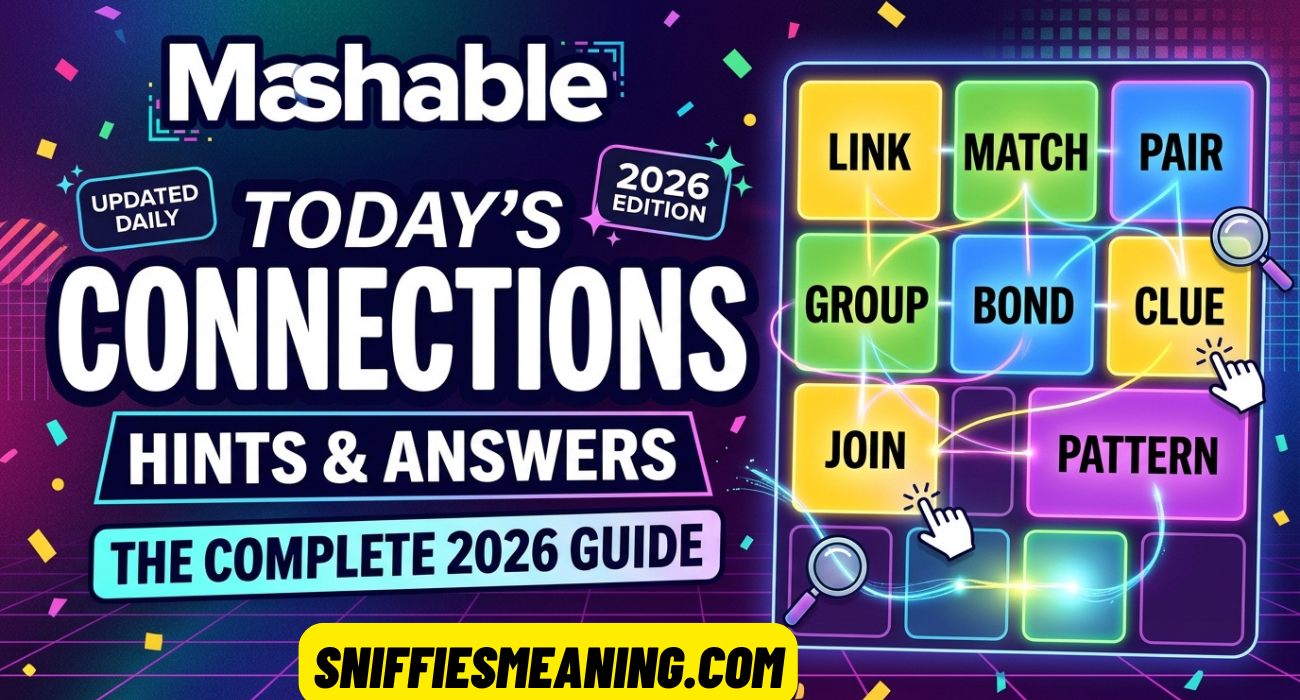
Mashable Connections Hint Today: Complete Guide 2026
Finding the right connection between 16 words is not always easy. Some groups look obvious, while others hide surprising meanings, wordplay, and tricky relationships. That is why many players search for Mashable Connections Hint Today when they need a little help with the daily NYT Connections puzzle.
Mashable Connections hints give players useful clues without immediately revealing every answer. They can help you understand difficult categories, recognize hidden patterns, and avoid mistakes that cost valuable attempts.
This complete guide explains how NYT Connections works, why Mashable hints are popular, and how you can improve your solving skills. You will also learn practical strategies, common mistakes, and ways to approach difficult purple categories without spoiling the entire puzzle.
What Is NYT Connections?
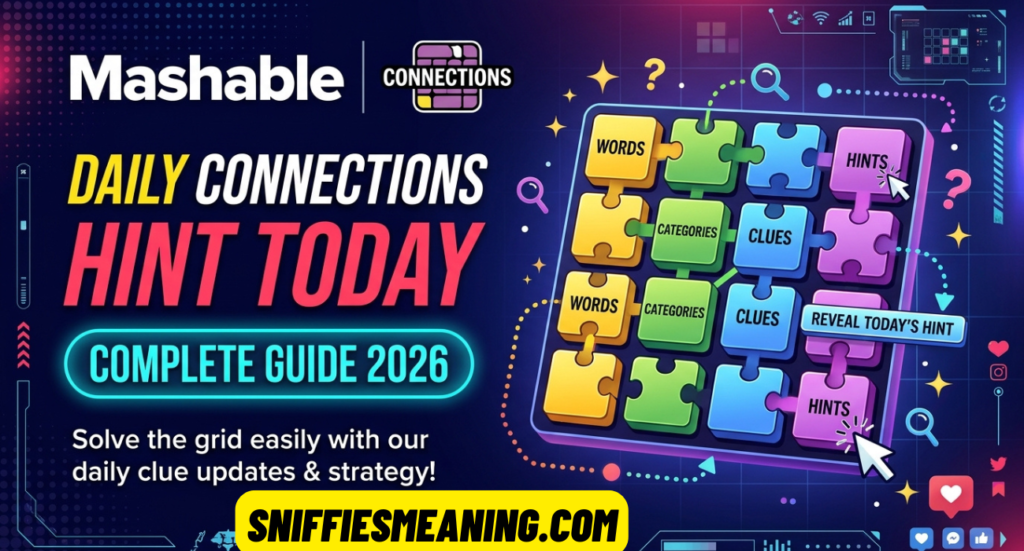
Connections is a daily word puzzle published by The New York Times. It presents players with 16 words arranged in a four-by-four grid. Your task is to organize those words into four groups of four based on a shared connection.
Each group follows a hidden theme. Some connections involve everyday objects, similar meanings, entertainment, expressions, or word patterns. Others depend on less obvious relationships that require creative thinking.
The objective is simple: identify all four groups using as few mistakes as possible. Players can make up to four mistakes before the game ends.
The puzzle resets daily, giving players a fresh challenge. Its combination of vocabulary, reasoning, and wordplay makes it appealing to casual players and dedicated puzzle fans.
Read Also : Error Codes FintechAsia – Full Guide to Fixing Common Issues Easily
Why Mashable Connections Hint Today Is So Popular
Mashable Connections Hint Today attracts players who want assistance without losing the enjoyment of solving the puzzle themselves.
Sometimes, you recognize several related words but cannot identify the exact category. In other cases, one misleading word makes an otherwise obvious group difficult to understand. A carefully written hint can help you see the relationship you missed.
Mashable’s daily puzzle coverage typically provides clues organized around the four color-coded categories. This allows readers to approach each group separately instead of looking for all the answers at once.
There are several reasons players use these hints:
- Time-saving assistance: A clue can help you move forward when you are stuck.
- Spoiler control: Category hints can provide direction before you look at the complete answers.
- Better understanding: Explanations help reveal why particular words belong together.
- Daily entertainment: Players can maintain their puzzle routine without abandoning difficult challenges.
- Learning opportunity: Repeated exposure to different word relationships can improve pattern recognition.
The biggest advantage is flexibility. You can use a small clue when you need direction or read a fuller explanation when the puzzle becomes frustrating.
How NYT Connections Puzzle Works
The game follows a simple format, but finding the correct relationships can take patience.
Every daily puzzle contains 16 words. You must select four words that share a meaningful connection. After selecting them, submit your group to check whether your theory is correct.
If the group is right, those words leave the board and receive a category color. If it is wrong, you lose one of your available attempts.
Here is the basic process:
- Open the daily Connections puzzle.
- Read all 16 words before selecting anything.
- Look for four words that share a clear relationship.
- Select those four words and submit your guess.
- Continue with the remaining words until you identify all four categories.
You can also shuffle the remaining words to view them from a different arrangement. This small feature can help you notice relationships that were difficult to see in the original layout.
Each puzzle has one intended solution, although several words may appear to fit more than one possible group. That overlap is a major part of the challenge.
Difficulty Colors
Connections uses four colors to identify the difficulty of its categories. Each color represents a different level of challenge.
| Color | Difficulty | What to expect |
|---|---|---|
| Yellow | Easiest | Direct meanings and familiar connections |
| Green | Moderate | Less obvious but recognizable relationships |
| Blue | Challenging | Specific knowledge or indirect associations |
| Purple | Hardest | Wordplay, hidden meanings, and unusual patterns |
Yellow categories usually involve familiar subjects, such as fruits, animals, sports, or household objects. Most players can recognize these relationships without much difficulty.
Green categories may require a little more thought. The words might share a purpose, function, or less obvious characteristic.
Blue categories often depend on specific knowledge, familiar names, cultural references, or specialized terminology.
Purple categories are generally the most challenging. They frequently involve wordplay, missing words, unusual spelling patterns, or expressions that become meaningful when combined with another word.
Remember that colors indicate relative difficulty, not fixed category types. A player who knows a particular subject may find a blue category easier than a yellow one.
Why You Get Stuck in Connections
Getting stuck does not necessarily mean you have poor vocabulary or weak problem-solving skills. The puzzle deliberately uses words that can suggest several different relationships.
For example, consider the words:
- Apple
- Orange
- Blackberry
- Cherry
You might immediately think about fruits. However, some of these words can also refer to technology, colors, or other familiar things.
This creates confusion because your brain may recognize multiple possible connections at the same time.
Another common problem is choosing a category too quickly. You might find three words that fit together and immediately search for a fourth. Unfortunately, the fourth word may belong to another group entirely.
Some players also struggle with cultural references. A category involving fictional characters, old expressions, music, or sports terminology can be difficult if you are unfamiliar with that subject.
The best solution is to slow down and examine the complete board. Connections rewards accurate relationships, not fast guesses.
What Makes Mashable Connections Guide Useful
A Mashable Connections guide can make the daily puzzle easier to understand by breaking the challenge into smaller clues.
Instead of showing every answer immediately, its daily coverage generally separates the hints, category descriptions, and complete solutions. This gives readers an opportunity to stop before reaching the spoilers.
The approach is useful because different players need different levels of assistance.
A beginner might only need a clue about the general subject. An experienced player might want to understand an unusual purple connection. Someone trying to protect a long winning streak may prefer a complete answer.
Here is how to get the most value from a daily hint guide.
Check the publication date: Make sure the guide matches the puzzle you are playing. Old Connections hints cannot reliably help with a new board.
Read the broad clues first: Try to identify the general themes before revealing the category names.
Return to the game: Give yourself time to reconsider the words after reading a clue.
Reveal stronger hints only when necessary: Avoid opening the complete answers if you still have a reasonable chance of solving the puzzle.
Study the explanation afterward: Understanding why a group works is more useful than simply remembering four correct words.
One important distinction is worth remembering: Mashable is a source of puzzle guidance, while the official daily Connections game is published by The New York Times. A third-party hint page does not control the original puzzle or its answers.
Smart Strategy to Solve NYT Connections Faster
Improving at Connections does not require an enormous vocabulary. You need a reliable method for examining words and testing possible relationships.
The following techniques can help you solve more puzzles with fewer mistakes.
Start With Obvious Groups
Begin by looking for words that share a clear and familiar meaning.
If you see four animals, musical instruments, colors, or types of food, examine those words first. These obvious relationships may reveal the easiest category.
However, do not submit a group simply because it looks convincing. Check whether one of the words could fit a different category more naturally.
A quick review can save an unnecessary mistake.
Focus on Category Thinking
Rather than connecting words individually, try to imagine a category that could explain four of them.
For example, if you see words such as:
- Keyboard
- Mouse
- Monitor
- Printer
You might recognize a computer-related category.
The important step is identifying the shared idea before selecting the words. Once you can explain the connection in a short phrase, your guess becomes easier to evaluate.
Use Elimination Method
Every correctly solved group removes four words from the board. This reduces the number of possibilities and makes the remaining puzzle easier to analyze.
Suppose you have already identified a group of four musical instruments. Remove those words mentally and focus on the other 12.
Do not keep reconsidering a category that you have already solved. Concentrate on the remaining relationships.
Elimination also helps prevent repeated guesses and unnecessary confusion.
Watch for Trap Words
Trap words are among the biggest challenges in Connections.
A trap word appears to fit one category but actually belongs somewhere else.
For example, the word Apple might suggest fruit. However, it could belong to a category involving major technology brands.
Likewise, words such as Orange, Gold, and Silver may appear connected through color but could represent something entirely different.
Before submitting a group, ask yourself whether another category explains those words more precisely.
Think in Patterns, Not Words
Some categories do not depend on the dictionary meanings of their words.
They may involve:
- Words that come before another word.
- Words that share the same ending.
- Expressions with a missing word.
- Different meanings of one familiar term.
- Similar sounds or spelling structures.
For example, CAT, DOG, and HOUSE might seem unrelated at first. But if the category involves words that can follow a particular phrase or appear in a familiar expression, their connection may become clearer.
Look beyond the obvious meaning whenever a group refuses to fit.
Example Breakdown: How Solving Works
A fictional example can demonstrate how to approach a Connections board without revealing the answers to an actual daily puzzle.
Read Also : About Blog WizzyDigital.org – Complete Guide & Insights
Imagine that your board contains these 16 words:
APPLE
BANANA
ORANGE
PEAR
VIOLIN
CELLO
TRUMPET
FLUTE
MERCURY
VENUS
EARTH
MARS
BUTTER
DRAGON
HOUSE
FIRE
Illustrative 16-word puzzle, not a real NYT daily board.
At first, you might notice some obvious connections. Others require more creative thinking.
Step 1: The “Obvious” Trap
APPLE, BANANA, ORANGE, and PEAR form a straightforward fruit category.
However, imagine that other words also suggest familiar subjects. Do not assume every apparent relationship is correct without checking all the possibilities.
Step 2: Spotting the Theme Group
VIOLIN, CELLO, TRUMPET, and FLUTE belong together because they are musical instruments.
This category becomes clear when you stop thinking about individual words and focus on their shared function.
Step 3: The Wordplay Group
MERCURY, VENUS, EARTH, and MARS are four planets in our solar system.
This is another example of a category based on shared knowledge rather than similar spelling.
Step 4: The Purple Finish
The remaining words are BUTTER, DRAGON, HOUSE, and FIRE.
At first, they seem unrelated. However, place the word “fly” after each one:
Butterfly, dragonfly, housefly, and firefly.
Suddenly, the relationship becomes clear.
This example demonstrates why Connections requires different types of thinking. Some groups rely on direct meanings, while others depend on familiar expressions and hidden word patterns.
Case Study: How One Streak Survived a Brutal Purple Category
Consider a hypothetical regular Connections player who has maintained a winning streak for several weeks.
One morning, the player encounters a difficult purple category. Three words appear connected through their everyday meanings, but the fourth word seems completely unrelated.
The player initially considers submitting the group. Instead, they pause and review the remaining words.
They identify two possible categories and notice that one word could fit either group. Rather than making a rushed selection, they solve a more obvious category first.
After four words disappear, the remaining board becomes easier to understand. The player recognizes that the difficult words share a missing word that creates four familiar expressions.
The final category is solved, and the streak continues.
The important lesson is not that every difficult category can be solved without mistakes. It is that patience and elimination can reduce unnecessary guesses.
This is an illustrative scenario, not a verified player testimonial or documented real-world case study.
Connections Compared to Other NYT Word Games
The New York Times publishes several popular word games. Connections shares some similarities with them, but its main challenge is different.
Here is how it compares with other familiar games.
| Game | Main challenge | How you play |
|---|---|---|
| Connections | Finding hidden relationships | Group 16 words into four categories |
| Wordle | Vocabulary and deduction | Guess a five-letter word |
| Strands | Word search and themes | Find hidden words related to a theme |
| Spelling Bee | Vocabulary and spelling | Create words using given letters |
| Mini Crossword | General knowledge | Complete a small crossword grid |
Wordle
Wordle focuses on guessing one hidden word through repeated attempts. Connections requires players to identify four separate relationships.
Strands
Strands involves finding hidden words in a letter grid. Connections presents all its words upfront but hides their categories.
Spelling Bee
Spelling Bee tests spelling and vocabulary by asking players to form words from selected letters. Connections tests the ability to recognize shared meanings and patterns.
Connections stands out because a word can have several meanings. You must discover the specific relationship intended by the puzzle rather than simply identify a correct definition.
Why Daily Practice Matters
Daily practice helps you become more familiar with the different ways Connections categories are created.
You may initially struggle with expressions, fictional characters, abbreviations, or unusual word combinations. However, regular exposure helps you recognize these patterns more quickly.
Practice also teaches you to avoid common traps. Once you understand that a word can belong to several possible themes, you become less likely to submit the first group that comes to mind.
Here are some benefits of regular practice:
Improved pattern recognition: You gradually become better at identifying shared meanings, phrases, and word structures.
Stronger vocabulary awareness: Different puzzles introduce unfamiliar expressions and alternative meanings.
Better decision-making: You learn to compare possible categories before using an attempt.
Greater confidence: Difficult purple groups become less intimidating when you understand common wordplay techniques.
More consistent results: A repeatable solving method can help you approach unfamiliar boards with greater control.
You do not need to spend hours practicing. One daily puzzle, followed by a short review of the categories, can provide a useful mental exercise.
Common Mistakes to Avoid
Even experienced players make mistakes when solving Connections. Most errors happen because they rush or focus on only one possible meaning.
Avoid these common problems:
| Mistake | Better approach |
|---|---|
| Selecting the first four related words | Check for alternative connections first |
| Ignoring unusual words | Consider wordplay and expressions |
| Guessing too quickly | Review the entire board |
| Overthinking simple categories | Start with direct relationships |
| Forgetting alternative meanings | Consider different contexts |
| Repeating failed guesses | Track which combinations you already tested |
| Reading complete answers too early | Use progressive hints |
One particularly important mistake is assuming that four related words must form a valid category.
For example, four words might all describe food. However, the intended connection could involve their spelling, a shared phrase, or something completely different.
The correct category must explain all four words accurately.
Another problem is ignoring the remaining board. Sometimes, a word that seems out of place is actually the key to identifying a difficult category.
Advanced Thinking Technique
Once you become comfortable with the basic rules, you can use more advanced reasoning techniques to solve challenging boards.
These methods are particularly useful when several words appear to fit multiple categories.
Reverse Category Thinking
Instead of asking which words belong together, start by imagining possible category names.
For example, consider categories such as:
- Things found in a kitchen.
- Words associated with money.
- Famous fictional characters.
- Words that follow a particular expression.
Then compare each possible category with the words on your board.
This reverse approach can reveal relationships that are difficult to recognize through individual word meanings.
Multiple Meaning Analysis
Many Connections words have more than one definition.
Consider the word Bank. It can refer to a financial institution or the side of a river.
If other words relate to water, the second meaning may be more important than the financial one.
Always examine different meanings before deciding where a word belongs.
Phrase Completion
Look for words that can complete familiar expressions.
For example:
- Butter ___
- Dragon ___
- House ___
- Fire ___
The missing word creates a common relationship between otherwise unrelated terms.
This technique is especially useful when approaching difficult wordplay categories.
Context Switching
If a group does not make sense, change the subject you are thinking about.
A collection of words might initially appear related to food. Try looking at technology, sports, entertainment, geography, or everyday expressions.
Changing context can help you escape an incorrect assumption.
Strategic Elimination
Do not waste attempts on groups that have several possible interpretations.
Instead, identify the strongest category, confirm it, and use the remaining words to build your next theory.
This creates a smaller and more manageable puzzle after every correct selection.
Why Every Puzzle Feels Different
One reason Connections remains interesting is the variety of relationships used in its daily puzzles.
Some days feature familiar categories such as animals, foods, colors, or occupations. Other days depend on entertainment knowledge, popular expressions, historical references, or unusual language patterns.
The difficulty also changes based on your personal knowledge.
For example, a person who follows sports may recognize a category involving famous athletes immediately. Someone who enjoys movies may find fictional character groups easier.
This means there is no single solving method that works equally well for every puzzle.
The best approach combines vocabulary knowledge, logical reasoning, elimination, and flexible thinking.
Where to Find Today’s Mashable Connections Hints
If you want help with the current puzzle, visit Mashable’s website and look for its latest Connections coverage.
You can also play the original puzzle directly through The New York Times.
Follow these steps to find the correct daily guide:
- Search for Mashable Connections Hint Today.
- Open the most recent relevant Mashable article.
- Check its publication date and puzzle number.
- Read the category clues before opening the complete answers.
- Compare the explanations with your puzzle board.
Important: Daily hints and solutions change with every puzzle. This article is a general guide to finding and using those hints, not a verified answer sheet for October 29, 2026. Always check the date before relying on a daily solution.
FAQs
What is Mashable Connections Hint Today?
Mashable Connections Hint Today refers to daily puzzle clues and answer guides published by Mashable for the New York Times Connections game. These guides help players identify hidden word groups without necessarily revealing every answer immediately.
Is Mashable Connections the same as NYT Connections?
No. NYT Connections is the original game published by The New York Times. Mashable provides independent daily coverage, including hints, category descriptions, and solutions.
How many words are in the Connections puzzle?
Each puzzle contains 16 words. Players must divide them into four groups, with four words in each group.
What is the hardest Connections color?
Purple is generally the hardest category. It often involves unusual wordplay, missing words, alternative meanings, or expressions that are not immediately obvious.
How many mistakes can you make in NYT Connections?
Players have four incorrect guesses available. Once all four mistakes are used, the game ends without completing the puzzle.
Does Mashable reveal the complete Connections answers?
Yes. Its daily coverage generally includes hints, category descriptions, and complete answers. Players can stop reading before the answer section if they want to avoid spoilers.
Can I play NYT Connections for free?
The New York Times Help Center lists Connections as free to play across its supported platforms. You can access the daily puzzle through the NYT Games website and supported apps.
When does the daily Connections puzzle reset?
The New York Times Help Center states that the daily puzzle releases at midnight in your local timezone. This means the new puzzle may become available at a different clock time depending on where you live.
Conclusion
Mashable Connections Hint Today is a useful search for players who want help solving the daily NYT Connections puzzle without immediately revealing every answer. Its hints can make difficult categories easier to understand while allowing players to enjoy the challenge.
The best way to improve is to combine hints with smart solving techniques. Start with obvious groups, examine alternative meanings, eliminate confirmed words, and pay special attention to hidden phrases in purple categories.
Most importantly, do not rush. Every puzzle offers a different challenge, and learning why four words belong together can make you a stronger player over time.
Whether you are protecting a winning streak or simply enjoying a daily word challenge, a good Connections guide can make the experience more rewarding.